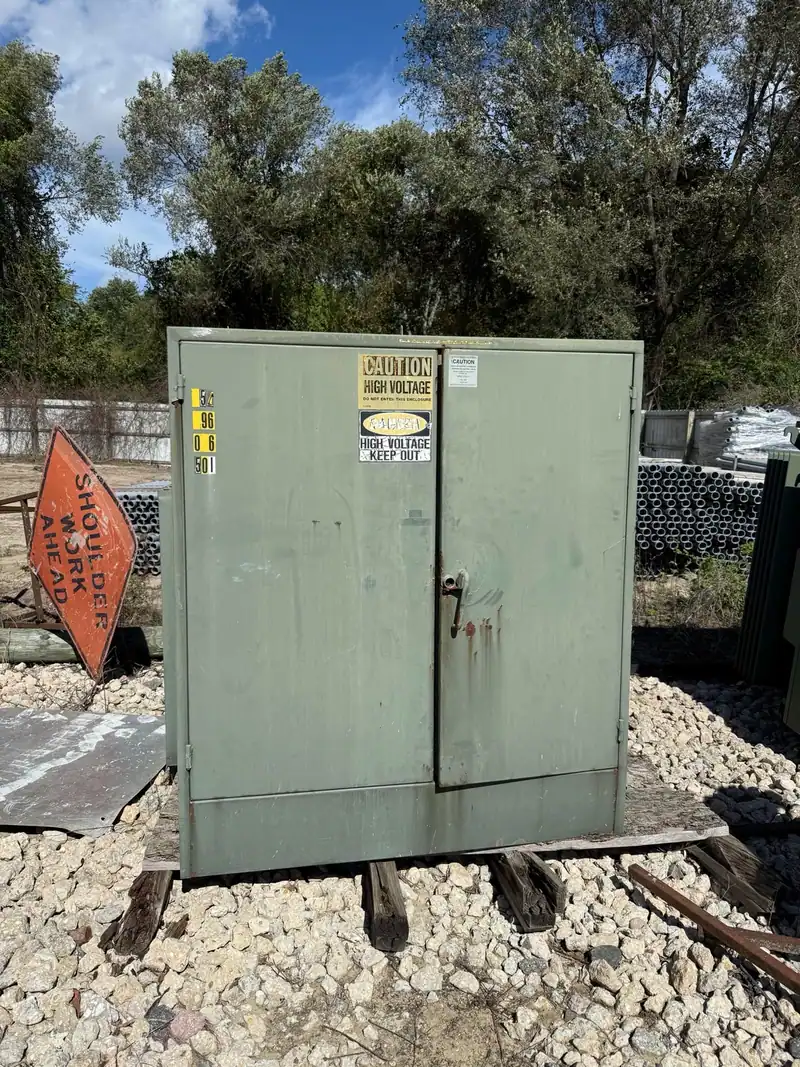
A 1,000 kVA transformer is a 1 MVA unit, a rating commonly found in manufacturing plants, data centers, campuses and large mixed-use buildings. We buy this equipment when projects change, facilities replace electrical infrastructure or surplus inventory is no longer needed. At this size, the voltage combination, construction and removal access matter as much as the headline rating.
If you want to sell 1,000 kVA transformer equipment, start with the actual nameplate rather than an inventory description. A transformer labeled 1 MVA may belong in this size category, while one showing several cooling ratings needs a closer look. Our transformer size guide helps you distinguish the rating from nearby sizes.
01What the 1,000 kVA Rating Means
The 1,000 kVA rating describes apparent power capacity under the conditions specified for the transformer. It does not mean the equipment always draws that amount of power, and it is not automatically a 1,000 kW load rating. Real power in kW depends on the connected load's power factor.
For three-phase equipment, full-load current depends on the line-to-line voltage. The formula is amps = kVA × 1,000 ÷ (√3 × volts). For example, a 1,000 kVA secondary rated 480Y/277 volts has a calculated full-load current of about 1,203 amps at 480 volts. Use the amp table on this page for other voltages, or see our kVA and full-load amps guide.
Check whether 1,000 kVA is the base rating or a rating reached with additional cooling. An oil-filled nameplate may list ONAN and ONAF ratings, distinguishing natural cooling from forced-air cooling. Send the entire rating plate so we can identify the unit correctly, including any fan-dependent capacity.
02Common Forms of 1,000 kVA Equipment
We buy three-phase pad-mount transformers at this size. These typically combine a liquid-filled tank with enclosed cable compartments. Photos of the exterior and available connection details help establish whether the unit has dead-front or live-front construction, its connection arrangement and any visible cabinet damage.
We also buy unit substation equipment, where the transformer connects to associated primary or secondary equipment. Tell us whether you are selling the transformer alone or an assembly that includes switches, transition sections or low-voltage switchgear. The scope of the sale needs to be clear before an offer is written.
A 1,000 kVA substation transformer may have exposed bushings, separate termination arrangements or connections to bus duct. We buy dry-type and cast resin units too. Construction affects application and handling, so identify the cooling medium and include photos showing the terminals, enclosure and accessories.
Full-load amps for a 1,000 kVA three-phase transformer
The amp table on this page uses the standard formula Amps = kVA × 1,000 ÷ (1.732 × line-to-line volts). Match the voltage on your nameplate to read the rated full-load current of each winding.
| Winding voltage | Full-load amps |
|---|---|
| 208 V | 2,776 |
| 240 V | 2,406 |
| 480 V | 1,203 |
| 600 V | 962 |
| 2,400 V | 241 |
| 4,160 V | 139 |
| 12,470 V | 46.3 |
| 13,200 V | 43.7 |
| 13,800 V | 41.8 |
| 23,000 V | 25.1 |
| 34,500 V | 16.7 |
03Voltage Combinations and Nameplate Details
Common examples include a 12,470-volt or 13,200-volt primary with a 480Y/277-volt secondary. Some installations use a 208Y/120-volt secondary or other distribution voltages. A marking such as 12470GrdY/7200 describes a grounded-wye voltage designation; copy the complete marking instead of shortening it to a single number.
The nameplate should confirm three-phase operation and a rating of 1,000 kVA or 1 MVA. We pay attention to primary and secondary voltages, winding connections, frequency, impedance, tap range and serial number. Impedance matters to system compatibility and fault-current calculations, but sellers should leave application decisions to their qualified electrical professionals.
Include readable photos of separate fluid, wiring and accessory plates when present. FR3 natural ester and mineral oil are different insulating fluids, and the fluid type should not be guessed from the tank's appearance. Any listed IEEE C57 standard is useful identification information, but it does not replace current condition records or documented PCB status.
- Capture the complete nameplate straight on, with enough resolution to read small fields.
- Photograph any separate cooling-rating or winding-connection diagrams.
- Report the current tap position if it is already documented.
- Include available test reports with dates and the transformer serial number.
04Physical Size, Weight and Site Access
There is no single shipping weight or footprint for a 1,000 kVA transformer. Liquid-filled pad-mount, ventilated dry-type and unit substation designs can differ substantially. Enclosures, radiators, fluid volume and attached equipment all affect handling. Use the manufacturer's documented weight and actual dimensions rather than an estimate based only on kVA.
Tell us whether the unit sits outdoors on a pad, inside an electrical room or behind other equipment. Door openings, overhead clearance, truck access and the route from the transformer to the loading area can determine what arrangements are practical. Include wide-angle site photos as well as close-ups of the equipment.
Identify attached bus duct, cable compartments or transition sections that may affect the shipping dimensions. Sellers must use their own qualified electricians to de-energize and disconnect equipment; we do not perform electrical disconnect work. Do not drain fluid for the sale. Freight and loading responsibilities belong in the written offer.
05What Drives Demand for a 1 MVA Transformer
A 1,000 kVA rating serves a useful range of commercial and industrial distribution loads. Manufacturing facilities may use it for production areas, while campuses and mixed-use properties may use it for building distribution. Data center applications can also use this size, although each project has its own voltage, reliability and equipment specifications.
Demand is configuration-specific, not just size-specific. A buyer needing 480Y/277 volts cannot treat a 208Y/120-volt unit as an equivalent replacement. Primary voltage, impedance, termination style, dimensions and condition can all determine whether a particular transformer fits an available application.
New-surplus equipment and documented operating units provide different information to a buyer than equipment with an unknown history. Tell us about storage conditions, the last known service date and any leaks, overheating or repairs. We buy failed units case by case, but the 1 MVA rating alone does not establish suitability or an offer amount.
06Send the Details Needed for a Written Offer
To sell 1,000 kVA transformer equipment, send a clear nameplate photo, overall photos, location, quantity and condition notes. We review the information and may ask about documented PCB status, test data or site access. If the equipment fits, we send a written offer covering price, freight, loading and payment terms; pickup is scheduled with you, and payment follows those terms. See how the purchase process works for details.
Include whether the transformer is still connected, disconnected or already in storage, along with any known damage or missing components. If several units are available, match each nameplate to its overall photos. Send your information through the equipment offer form so we can review the actual configuration.
Frequently asked questions
Is a 1 MVA transformer the same size as a 1,000 kVA transformer?
Yes, 1 MVA equals 1,000 kVA. The distinction matters when inventory lists use MVA but the nameplate uses kVA, or vice versa. Check the cooling ratings too: a plate with multiple capacities may identify a base rating and a higher forced-air rating. Send a photo of the full plate rather than reporting only the largest number.
Can I sell a 1,000 kVA transformer with a 208Y/120 secondary?
Yes, we buy 1,000 kVA three-phase transformers with 208Y/120-volt secondaries as well as other voltage configurations. Send the complete primary voltage, winding connection and nameplate information. Secondary voltage affects application fit and connection requirements, so a 208Y/120 unit should not be described as interchangeable with a 480Y/277 unit.
Do you buy a 1,000 kVA transformer without its switchgear?
Yes, we buy standalone 1,000 kVA transformers, including units offered separately from associated switchgear. Identify exactly which components are included and show the transformer connections in photos. For a unit substation, note any transition sections, flanges or accessories that remain with the equipment so the sale scope is unambiguous.
Can I sell a 1,000 kVA transformer that has been stored outside?
Yes, we buy stored 1,000 kVA transformers, but storage conditions and construction matter. Tell us how long it has been stored, whether openings were protected and whether there are leaks, corrosion or missing parts. Outdoor storage of equipment designed for indoor service needs particular attention. Failed or damaged units are reviewed case by case.
Do you need the exact weight of my 1,000 kVA transformer?
A documented weight is useful for planning freight and loading, but send the available equipment details even if the weight is not yet known. Look for weight information on the nameplate, outline drawing or manufacturer's documentation. Do not substitute a generic weight for this rating, because construction and attached components can change it substantially.
Can you review an older 1,000 kVA oil-filled transformer?
Yes, we buy older oil-filled transformers, with PCB status disclosed and documented. Age alone does not establish PCB status, and the original fluid designation may not describe later fluid changes. Send available fluid records, nameplate photos and condition notes. Do not drain the transformer or assume undocumented equipment qualifies for an offer.