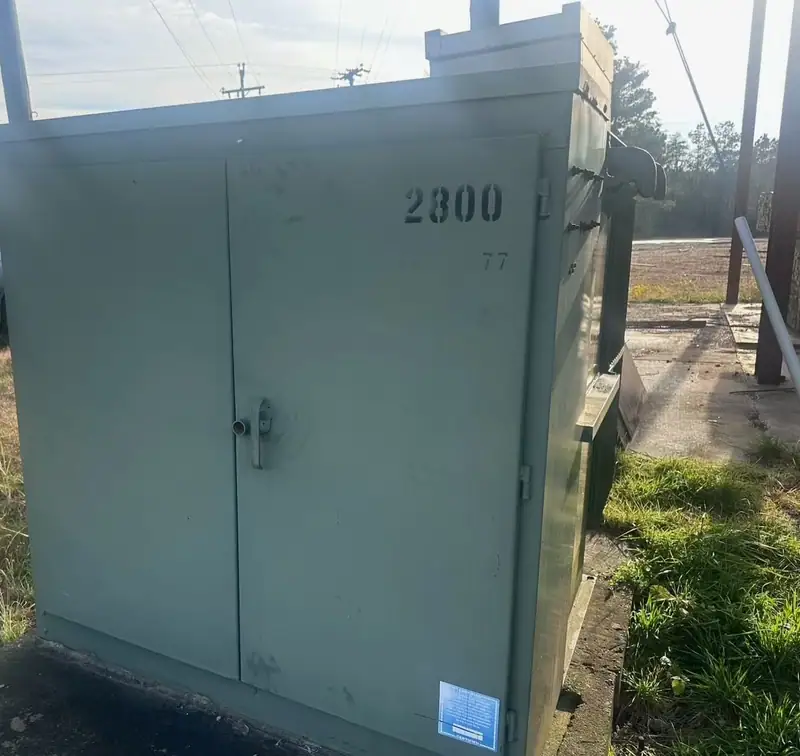
We buy three-phase pad-mount transformers housed in the familiar green, tamper-resistant cabinets installed on concrete pads. These units supply commercial buildings, industrial loads, data centers and solar sites. Cabinet color alone tells us little; voltage, capacity, connection layout and condition determine what equipment you have.
As a pad-mount transformers buyer, we pay attention to both the transformer and its high-voltage compartment configuration. A loop-feed unit with dead-front elbows is not interchangeable with every radial-feed installation. This page covers three-phase equipment; our single-phase pad-mount page covers residential-style and other single-phase units.
01Three-Phase Pad-Mount Equipment We Buy
We buy all brands of three-phase pad-mount transformers, including equipment that is still installed but scheduled for retirement. Used units, decommissioned equipment and unused project overages can all be suitable. Failed or damaged units receive case-by-case review rather than being treated like operating surplus.
Capacity is only one part of the description. A 300 kVA transformer serving a commercial building and a 2,000 kVA transformer from a large facility may have very different primary voltages, secondary arrangements and cabinet dimensions. Send the actual ratings instead of describing either unit simply as a green transformer.
Tell us whether the equipment came from building service, industrial distribution, a data center project or a solar installation. Include whether it was energized, held as a spare or purchased for a canceled project. Application history helps explain the nameplate, but it does not replace the electrical ratings.
02Loop Feed, Radial Feed and Compartment Design
Loop-feed pad-mount transformers typically provide two sets of primary connections, allowing an incoming and outgoing cable arrangement. Radial-feed units typically have one set of primary connections. The connection count is useful, but it does not establish how the transformer was connected or whether a site operated as an open loop.
Dead-front construction uses insulated, shielded separable connectors at the primary interface. Live-front construction has exposed energized primary connection components when operating. These distinctions affect installation compatibility, so identify the design from existing records or photos taken while equipment is safely de-energized and accessible.
Also report any internal load-break switch and its labeled positions. Elbow interface ratings, bushing arrangements and switch configurations can vary between otherwise similar units. Do not open an energized compartment for sales photos; a qualified person should handle access under the site's electrical safety procedures.
- Identify radial-feed or loop-feed construction if known.
- Record dead-front or live-front primary connections.
- Include primary interface ratings shown on labels.
- Describe damaged bushings, missing inserts or disconnected accessories.
- Photograph the compartment layout only when safe access is authorized.
03What the Nameplate Reveals About Your Unit
A readable nameplate gives us the unit's kVA, phase, frequency, primary and secondary voltages, impedance, serial number and manufacturing date where listed. Ratings such as 12470GrdY/7200 and 480Y/277 describe more than voltage magnitude: the notation also identifies grounded-wye relationships. Photograph the full plate straight on, with enough resolution to read the smaller fields.
We also look for winding material, temperature rise, basic impulse insulation level, fluid quantity and total weight when provided. Larger units may list ONAN or ONAN/ONAF cooling ratings. Separate ratings can indicate different capacities under natural cooling and fan-assisted operation; include all listed ratings rather than reporting only the largest number.
The connection diagram and tap table are especially useful when labels are faded or purchase records are incomplete. Our transformer nameplate guide explains common fields. If a nameplate is missing, send any available drawings or specifications, clearly identifying which records belong to the unit being sold.
04Fuses, Tap Changers and Insulating Fluid
Bayonet fuses and current-limiting fuses tell us about the protection arrangement. Some pad-mount designs pair a removable bayonet fuse with a series backup current-limiting fuse, but not every unit uses that combination. Share fuse labels, protection drawings or maintenance records if available; do not assume the installed fuse matches the original specification.
A de-energized tap changer adjusts the winding ratio within the listed tap range and must not be operated while energized. Send the tap table and current position if documented. Tell us about a broken handle, unreadable indicator or known tap mechanism problem instead of moving the selector to check it.
Mineral oil and FR3 natural ester are different insulating fluids, and the fluid label matters. FR3 is a natural ester fluid used in liquid-filled transformers; its presence does not establish the unit's PCB status. Disclose and document PCB status, identify leaks or previous fluid changes, and leave the fluid in place. We do not ask sellers to drain transformers.
05New-in-Crate Overages and Stored Project Equipment
We buy new-surplus pad-mount transformers left over from project changes, canceled builds and unused spare inventories. A unit still in its crate needs the same rating information as an installed transformer. Include the order specification, factory documentation and accessible nameplate photos without disturbing protective packaging unnecessarily.
Tell us whether the unit has ever been energized and how it has been stored. Outdoor storage, damaged packaging, corrosion, fluid seepage and missing accessories should be reported even when the equipment was never used. New-surplus describes its use history, not a guarantee that every component remains in its original condition.
For multiple units, provide a separate serial number and condition note for each transformer. Matching cabinets can hide differences in voltage, impedance, taps or fluid type. As an independent pad-mount transformers buyer, we buy all brands and are not affiliated with any manufacturer, including Virginia Transformer Corp of Roanoke.
06Selling a Transformer Still Sitting on Its Pad
A pad-mounted transformer may remain connected to underground primary cables and secondary conductors long after a building closes. Confirm ownership and whether utility equipment or customer-owned equipment is involved before offering it. We do not perform electrical disconnect work; sellers use their own qualified electricians to de-energize and disconnect.
Describe access around the pad, gates, overhead restrictions, nearby structures and the distance to an accessible loading area. Include the listed weight and photos showing the cabinet base and surrounding ground. Loose equipment in a storage yard presents different loading conditions from a transformer enclosed by walls or landscaping.
Send nameplate and overall photos, location, quantity and condition notes through Get an Offer. We review the information and may ask about PCB documentation, test data or access; if the equipment fits, the written offer spells out price, freight, loading and payment terms. Pickup is scheduled with you, and payment follows those terms; see how the sale works for details.
Frequently asked questions
Can I sell a loop-feed transformer that was used on a radial circuit?
Yes, we buy loop-feed pad-mount transformers even when their previous installation used a radial circuit. Describe the transformer’s actual connection configuration, not just the site wiring. Send the nameplate and any safely available compartment photos, and note whether unused interfaces have protective caps or whether bushings, inserts or other components are missing.
Do you buy pad-mount transformers with blown bayonet fuses?
We review pad-mount transformers with blown fuses case by case because a blown fuse can indicate different underlying problems. Tell us what happened and provide existing test or maintenance records if available. Do not replace or energize equipment just to prepare it for sale. Our failed transformer page covers equipment with known electrical faults or damage.
Can I sell an FR3-filled pad-mount transformer?
Yes, we buy FR3-filled pad-mount transformers as well as mineral-oil-filled units. Identify the fluid from the equipment label or reliable records, and disclose any known fluid replacement, mixing or leakage. PCB status must be disclosed and documented regardless of the stated fluid type. Keep the fluid in the transformer rather than draining it for transport or sale.
What if the utility owns the pad-mount transformer on my property?
You should not offer a utility-owned transformer for sale unless you have authority from its owner. Physical location on your property does not establish ownership. Check service records, asset markings and ownership documentation with the utility or responsible party. We do not provide legal advice, and electrical disconnection must be handled by your own qualified electricians.
Do new-in-crate pad-mount transformers need to be unpacked for an offer?
A new-in-crate pad-mount transformer does not necessarily need to be fully unpacked for an initial review. Send accessible nameplate photos, packaging labels and matching factory specifications, along with storage and condition notes. Explain what cannot be photographed without removing packaging. We may ask for additional information when the records do not establish the unit’s ratings or condition.
Can you review a pad-mount transformer with a rusted cabinet?
Yes, we review pad-mount transformers with cabinet rust, with damaged units handled case by case. Show whether corrosion affects only the exterior finish or also the base, hinges, doors or tank. Disclose holes, fluid leaks and compromised locks. Do not conceal deterioration with fresh paint; clear condition photos help distinguish cosmetic wear from damage.