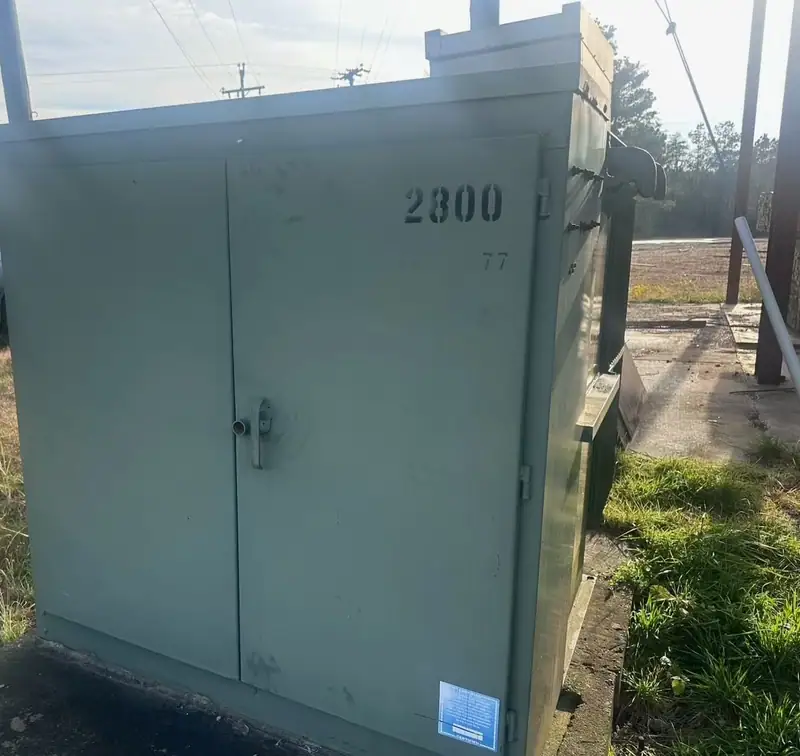
A 300 kVA three-phase transformer often serves a shopping center, apartment complex or industrial production line. That rating can appear on very different equipment: an outdoor pad-mount with enclosed cable compartments, an indoor ventilated dry-type unit or a transformer connected to substation switchgear. We buy all brands, but the nameplate and construction tell us more than the manufacturer name alone.
If you want to sell 300 kVA transformer equipment after a service upgrade, tenant change or plant shutdown, start by confirming the actual rating and voltages. Do not rely on an equipment list that may describe the entire electrical service rather than the individual transformer. Our transformer size guide helps distinguish this rating from nearby sizes.
01What the 300 kVA Rating Actually Means
A 300 kVA rating describes the transformer's apparent-power capacity under its specified operating conditions. For a three-phase transformer, it is the total three-phase rating, not 300 kVA per phase. It also does not automatically mean 300 kW of usable load: real power depends on load power factor, and allowable loading depends on the equipment's ratings and operating conditions.
This distinction matters when a seller has three separate single-phase transformers instead of one three-phase unit. Three 100 kVA units can form a 300 kVA bank, but they are not the same equipment as one 300 kVA three-phase transformer. Send the plate from each unit when selling a bank. We also pay attention to listed temperature rise, cooling class and any multiple ratings, rather than treating every prominent number on the plate as the base capacity.
02Pad-Mount, Dry-Type and Substation Configurations
We buy 300 kVA three-phase pad-mount transformers with enclosed high- and low-voltage compartments. At this size, connection details matter: dead-front versus live-front construction, loop-feed versus radial-feed arrangements, and the number and type of bushings. Photographs of accessible compartments help distinguish units that look nearly identical from outside; only photograph them when safe access has been established.
We also buy 300 kVA dry-type transformers, including ventilated and cast resin equipment. Enclosure condition, coil condition and signs of moisture or overheating are useful details. A dry-type unit from an indoor electrical room differs substantially from an outdoor liquid-filled unit, even when both supply the same secondary voltage.
For 300 kVA substation transformers, show the transformer and its connections to surrounding equipment. Close-coupled switchgear, terminal chambers and bus connections can affect handling and reuse. Tell us whether the sale includes only the transformer or also associated sections, and identify any missing covers, bushings or connection hardware.
Full-load amps for a 300 kVA three-phase transformer
The amp table on this page uses the standard formula Amps = kVA × 1,000 ÷ (1.732 × line-to-line volts). Match the voltage on your nameplate to read the rated full-load current of each winding.
| Winding voltage | Full-load amps |
|---|---|
| 208 V | 833 |
| 240 V | 722 |
| 480 V | 361 |
| 600 V | 289 |
| 2,400 V | 72.2 |
| 4,160 V | 41.6 |
| 12,470 V | 13.9 |
| 13,200 V | 13.1 |
| 13,800 V | 12.6 |
| 23,000 V | 7.5 |
| 34,500 V | 5 |
03Voltage Combinations and Full-Load Current
Common 300 kVA configurations include medium-voltage primaries such as 12470GrdY/7200 feeding 480Y/277 or 208Y/120 secondaries. A 480 V primary with a 208Y/120 secondary is also common on dry-type distribution equipment. These are examples, not interchangeable specifications. Primary connection, insulation ratings, taps and secondary configuration all matter when identifying a unit.
Use the amp table on this page to compare full-load current at different three-phase voltages. For one worked example, the formula is I = kVA × 1,000 ÷ (√3 × line-to-line volts). At a 480 V secondary, a 300 kVA transformer has a calculated full-load current of 300 × 1,000 ÷ (√3 × 480), approximately 361 A. Our kVA and full-load amps guide explains the relationship. This calculation does not select conductors, protective devices or allowable loading for an installation.
04Confirm the Rating From the Nameplate
A useful nameplate photograph captures the entire plate straight on, with enough resolution to read the smaller fields. Confirm that it states 300 kVA and three phases, then look for primary and secondary voltages, frequency, serial number and impedance. Tap markings show available voltage adjustments; they do not change the transformer into a different nominal kVA size.
On liquid-filled equipment, include the fluid designation, fluid quantity and cooling information if shown. Mineral oil and FR3 natural ester are different insulating fluids, so do not describe either simply as oil when the plate gives a specific designation. Cooling classes such as ONAN or ONAN/ONAF also deserve a clear photo. If the plate references an IEEE C57 standard, preserve that information in the image rather than sending only a typed summary.
- Photograph any separate rating, fluid or accessory labels.
- Include manufacturer drawings or test records if available.
- Disclose and document PCB status; do not infer it from age or appearance.
05Physical Size, Weight and Site Access
There is no single reliable footprint or shipping weight for every 300 kVA transformer. Liquid-filled pad-mount equipment includes a tank, fluid and cable compartments, while a dry-type unit has a different enclosure and lifting arrangement. Copper versus aluminum windings, enclosure design and accessories can also affect weight. Use the manufacturer's listed weight and actual dimensions instead of estimating from the kVA rating.
For an outdoor unit, show the pad, nearby fencing, vehicle approach and overhead obstructions. For an indoor transformer, identify door widths, stairs, elevators and the route out of the electrical room. Tell us whether it remains attached to switchgear or buswork. These details help define freight and loading terms. We do not perform electrical disconnect work; sellers use their own qualified electricians to de-energize and disconnect equipment. Do not drain fluid for the sale.
06What Makes a 300 kVA Unit Useful to Another Buyer
The 300 kVA size fits a range of commercial distribution and industrial load applications. Shopping-center loads, apartment-building services and production equipment may use this capacity, but suitability depends on the actual load and electrical design. The rating alone does not establish demand or value. We pay attention to common voltage combinations, complete connection hardware, readable identification and documented condition when reviewing a unit for purchase.
To sell 300 kVA transformer equipment, send clear nameplate and overall photos, location, quantity and condition notes through our offer request form. We review the details and may ask about PCB documentation, test data or access. If the equipment fits, we send a written offer specifying price, freight, loading and payment terms, then schedule pickup with you. Payment follows those written terms. See how the sale works for details.
Frequently asked questions
Can I sell a 300 kVA transformer with a 208Y/120 secondary?
Yes, Virginia Transformer Buyers buys 300 kVA three-phase transformers with 208Y/120 secondaries. Include the primary voltage and winding configuration because the secondary voltage alone does not fully identify the unit. A medium-voltage pad-mount and a 480 V primary dry-type transformer can share that secondary rating while serving different applications.
Is a bank of three 100 kVA transformers the same as one 300 kVA transformer?
No, a bank of three 100 kVA single-phase transformers is physically different from one 300 kVA three-phase transformer. The bank can provide a combined 300 kVA rating in an appropriate three-phase arrangement. Virginia Transformer Buyers buys both forms, but needs individual nameplate photos and condition information for each transformer in a bank.
Can I sell a 300 kVA transformer that is still installed?
Yes, Virginia Transformer Buyers can review a 300 kVA transformer while it is still installed. State whether it is energized, disconnected or scheduled for retirement, and photograph its surroundings from a safe position. We do not perform disconnect work. Your qualified electrician must handle de-energizing and disconnection, and access and loading requirements belong in the written terms.
Will you buy a failed 300 kVA dry-type transformer?
Failed 300 kVA dry-type transformers receive case-by-case review. Describe the known failure, including overheating, winding damage or moisture exposure, and provide photographs without opening energized equipment. Include available test reports and identify missing parts. Do not describe a failed unit as operational merely because its enclosure and nameplate remain intact.
Does an older 300 kVA oil-filled transformer need PCB documentation?
PCB status must be disclosed and documented when offering an oil-filled transformer to Virginia Transformer Buyers. Age, paint color and general appearance do not establish that status. Send available fluid labels and supporting records, and identify anything unknown. We do not ask sellers to drain fluid or provide environmental advice.