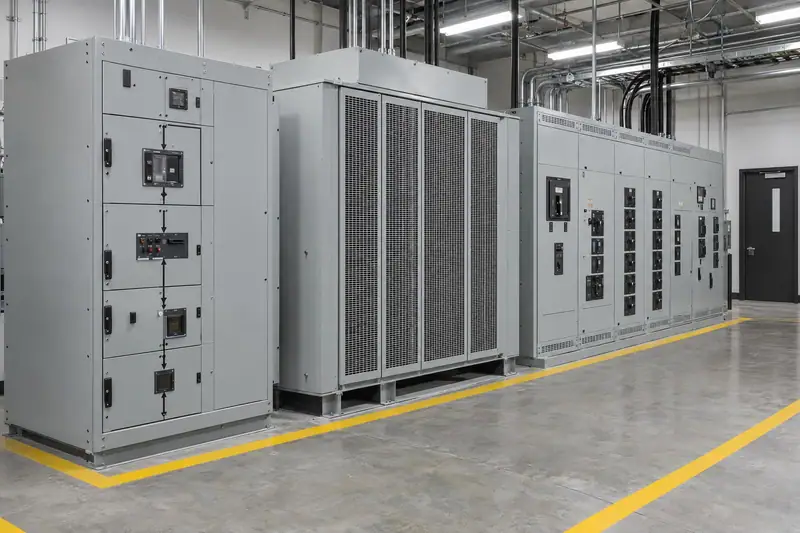
A unit substation is more than a transformer sitting beside a switchboard. Its incoming equipment, transformer and outgoing distribution equipment form a coordinated, close-coupled assembly. As a unit substations buyer, we pay attention to how those sections connect, which components remain available and whether the assembly can leave the building without damage.
We buy equipment from plant closures, campus upgrades, facility replacements and surplus inventories throughout Virginia. A complete lineup and an isolated transformer section need different documentation. See our broader transformer buying categories if your equipment includes separate outdoor transformers or other units outside the lineup.
01Primary and Secondary Unit Substations
A secondary unit substation commonly combines an incoming medium-voltage switch, a transformer and low-voltage switchgear or a switchboard. The transformer might carry a 12470GrdY/7200 primary designation and a 480Y/277 secondary. Those ratings help identify the electrical arrangement, but photos are needed to show the actual equipment supplied.
A primary unit substation generally steps a higher distribution voltage down to another medium-voltage level. Its outgoing equipment may therefore be medium-voltage switchgear rather than low-voltage gear. Sellers sometimes use the same label for both arrangements, so send the voltage ratings instead of relying on the facility's equipment name.
We buy liquid-filled, dry-type and cast resin transformer sections. Cooling class, impedance, taps and enclosure configuration matter alongside kVA. A close-coupled unit belongs in this review even when its transformer resembles one of the separate substation transformers we buy.
02Selling the Whole Lineup or Only the Transformer
We buy unit substation transformer sections and review complete lineups that include the incoming and outgoing equipment. Tell us exactly what is available. A transformer offered with its primary switch and secondary gear is different from a transformer whose adjoining sections must remain in service or stay with the building.
For a complete lineup, identify every section and any missing breakers, fuses, bus links, covers or protective relays. Photos should show the front and rear where safely accessible. Matching drawings and section identifiers help establish whether the pieces belong to the same assembly.
For a transformer-only sale, document the primary and secondary interfaces, including bus throats, flanges, terminal chambers and any attached transition sections. Do not assume adjoining switchgear is included in the purchase. The written offer should clearly distinguish the transformer, included accessories and any other accepted sections.
03Document Each Section, Not Just the Transformer
One transformer nameplate does not describe an entire unit substation. Send a clear plate photo from each available section, along with an overall photo showing their order. Record manufacturer, serial number and section designation so a plate can be matched to the correct enclosure.
On the transformer, we pay attention to kVA, primary and secondary voltage, phase, frequency, impedance, tap range and cooling designation. For liquid-filled units, include the fluid designation, fluid volume and listed weights. ONAN/ONAF ratings can indicate separate self-cooled and fan-assisted capacities; photograph both ratings when present.
Switch and switchgear information helps describe what accompanies the transformer. Capture voltage class, continuous-current rating, interrupting or withstand ratings as applicable, breaker details and lineup drawings. If IEEE C57 standards appear on the transformer plate or records, include those details without treating them as proof of its present condition.
- Transformer: nameplate, terminal arrangement, cooling equipment and condition photos.
- Incoming section: switch or interrupter identification, fuse information and enclosure plate.
- Outgoing section: assembly plate, main and feeder breaker labels, and missing-component notes.
- Supporting records: one-line diagram, outline drawing, available test reports and maintenance notes.
04Indoor Access Can Determine the Removal Plan
An indoor unit substation may have been installed before walls, doors or adjacent equipment were completed. Photograph the route from the equipment room to the proposed loading point. Include narrow doorways, turns, thresholds, ramps, overhead obstructions and any elevator or floor opening along that route.
Provide section dimensions and documented weights when available. Floor loading is not simply the transformer's total weight divided by its footprint: concentrated loads from moving equipment also matter. Have your qualified site professionals establish permissible loads and a suitable removal approach; we do not provide engineering advice.
Tell us whether the room is at grade, on an upper floor or below grade, and whether other equipment blocks access. These details help define the freight and loading terms rather than leaving access assumptions unresolved. Our transformer pickup preparation guide covers additional information sellers should gather.
05Splitting a Lineup at Throats and Shipping Sections
Close-coupled connections can include bolted bus, flexible connectors and enclosed throats between sections. A visible enclosure seam does not necessarily identify a safe shipping split. Original outline drawings and installation instructions can show intended shipping sections, connection details and lifting provisions.
Send photos of accessible connection areas without opening energized equipment. We want to know which throat components, covers, fasteners and bus connections will accompany the sale. Missing transition pieces can affect how the transformer section can be reused, even when its electrical ratings remain suitable.
Sellers must use their own qualified electricians to de-energize and disconnect the equipment. We do not perform electrical disconnect work. Qualified personnel should handle separation and secure disconnected components according to the equipment requirements; for dry-type transformer sections, protecting exposed windings and insulation from impact and moisture is especially important.
06Plant Closures, Campus Upgrades and Surplus Lineups
Plant closures may leave several similar substations with different transformer ratings, breaker configurations or service histories. Campus upgrades can release a working transformer while parts of its distribution lineup remain. Label each available unit consistently so nameplates, photos and condition notes do not get mixed between rooms.
We buy all brands and sizes, including three-phase transformers from 15 kVA through MVA-class equipment. Manufacturer names identify the equipment, not an affiliation with our business. For liquid-filled sections, disclose and document PCB status; an FR3 natural ester label or another fluid designation should be photographed along with available fluid records. Failed or damaged units are reviewed case by case.
Send your equipment information through the offer request form, including location, quantity and condition notes. We review the details and may ask about PCB documentation, test data or access; if the equipment fits, we send a written offer specifying price, freight, loading and payment terms, then schedule pickup with you. Payment follows those terms; see how the purchase process works.
Frequently asked questions
Can I sell the transformer if the unit substation switchgear stays?
Yes, we buy transformer sections without the adjoining switchgear. Identify which equipment stays and photograph both transformer interfaces, including attached throats and transition enclosures. Connection drawings help distinguish removable accessories from components belonging to the retained lineup. Your qualified electricians must handle de-energizing and electrical disconnection.
Do you need nameplates from every unit substation section?
Yes, send nameplates from each section offered with the transformer. The transformer plate does not establish the incoming switch or outgoing switchgear ratings. Match each photo to a section label or overall lineup photo, and include breaker labels where accessible. Note missing plates rather than substituting information from a nearby unit.
Will a unit substation fit through a standard equipment-room door?
That depends on the documented shipping-section dimensions and the actual removal route. Measure the clear doorway opening, not just the door's nominal size, and identify turns and overhead restrictions. Include drawings and section weights if available. Your qualified site professionals should determine the removal method and any floor-loading limitations.
Can I sell a unit substation with a failed transformer?
Failed unit substation transformers are reviewed case by case. Describe the failure, affected sections and any known damage to bus connections, enclosures or adjoining gear. Include available test reports and photos taken under safe conditions. Do not assume that unaffected switchgear makes the complete assembly acceptable or that a purchase offer is guaranteed.
Does a 2,500 kVA rating describe the entire unit substation?
No, 2,500 kVA describes the transformer's rated apparent-power capacity, not every section's electrical rating. Incoming switches and outgoing gear have their own voltage, current and other applicable ratings. For a 2,500 kVA transformer sale, send the transformer plate plus separate identification for any adjoining equipment included.