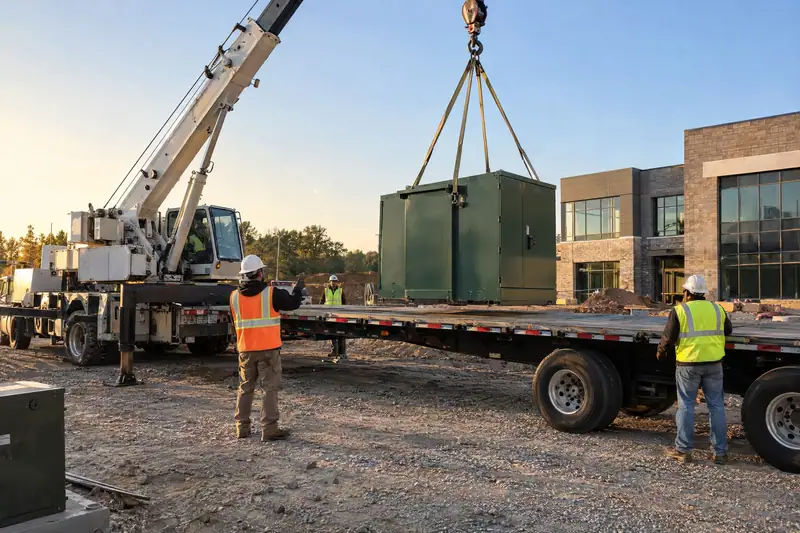
A transformer can be ready for sale without being ready to move. Connected cables, missing weight information, a narrow gate or an unsuitable loading surface can prevent a planned pickup. Preparing a transformer for pickup starts with identifying those constraints before transport is scheduled.
We buy pad-mount, substation, dry-type, pole-mount and MVA-class power transformers throughout Virginia. This guide focuses on the physical handoff: electrical isolation, fluid containment, lifting information and access. If you are still identifying the equipment, our seller guides provide background on transformer types and nameplate information.
011. Assign the electrical disconnect to qualified personnel
Use your own qualified electrician to de-energize and disconnect the transformer. Virginia Transformer Buyers does not perform electrical disconnect work. A switched-off transformer is not automatically ready for handling; qualified personnel must establish electrical isolation under the site's applicable safety procedures.
Tell the electrician about every connected source, including secondary circuits, generators, solar equipment and auxiliary supplies. Their work should include appropriate lockout/tagout, verification of the de-energized condition, and disconnection of electrical connections that would prevent removal. Do not cut cables or open energized compartments to speed up pickup.
Have qualified personnel properly cap or protect disconnected cable ends, terminals and openings as appropriate for the equipment. Ask them to identify any grounding or bonding connections that must remain until the appropriate stage of removal. Keep the isolation status clear to everyone involved, particularly when the transformer sits beside equipment that remains energized.
022. Leave fluid in place and document containment
Leave the insulating fluid in the transformer. We do not ask sellers to drain fluid before pickup. Draining changes the shipment's condition and weight, creates another material to manage, and can expose internal components to moisture. Report any existing leak or previous draining before loading is arranged.
Photograph fluid labels, accessible gauges, valves and any visible staining. Identify whether the unit contains mineral oil or another insulating fluid, such as FR3 natural ester, when documentation is available. Do not assume the fluid type or PCB status from the transformer's age, brand or appearance.
PCB status must be disclosed and documented. Send available records and identify missing information rather than guessing. Our guide to PCB transformer disclosure explains what sellers should gather. Qualified personnel should address leaks or damaged fittings before movement; do not improvise repairs or open valves for a photograph.
033. Record shipping weight, dimensions and configuration
Photograph the entire nameplate clearly enough to read the manufacturer, serial number, kVA, voltages and any listed weight. A rating such as 12470GrdY/7200 primary and 480Y/277 secondary identifies electrical characteristics, not lifting requirements. kVA alone is not a reliable way to determine transport weight.
Use the nameplate weight or manufacturer documentation when available, and identify exactly what that figure includes. Some records distinguish total weight, fluid weight and untanking weight. State whether the transformer still has its fluid, radiators, cabinet, fans or other attached components. An incomplete weight description can lead to unsuitable loading equipment.
Measure the equipment's overall shipping length, width and height, including projecting bushings, radiators and cabinets. For unit substation equipment, identify whether switchgear and transition sections remain attached or will be separated by qualified personnel. Label loose accessories and photograph them so the pickup inventory matches the equipment being sold.
044. Secure compartments and identify approved lifting points
After electrical work is complete, have appropriate personnel close and secure doors, access covers and loose panels for transport. Tell us about missing hinges, broken latches or doors that will not close. Keep bushings, gauges and cooling equipment protected from accidental contact without using them as attachment points.
Send clear photographs of lifting lugs, lifting eyes, the base and any manufacturer lifting instructions. A visible lug does not by itself establish that it is suitable for lifting the complete assembled transformer. Corrosion, damage, missing hardware and the difference between cover-lifting and whole-unit lifting points matter.
Qualified rigging personnel should select lifting points, rigging and load-handling methods using equipment documentation and actual condition. Do not assume a transformer can be lifted with forks because its base has an opening. Our pad-mount and substation comparison helps identify cabinet and construction differences, but it does not replace a unit-specific lifting plan.
055. Photograph the complete route to the loading area
Photograph the route from the transformer's current position to the proposed loading location. Include gates, doorways, corners, slopes, pavement transitions and overhead obstructions. A close-up of the transformer cannot show whether a truck can reach it or whether loading equipment has room to operate.
Record known gate widths, doorway heights and access restrictions. Tell us about gravel, soft ground, drainage structures, underground utilities, loading docks and areas with restricted load capacity. The transport and lifting providers need enough information to evaluate their access and setup; do not guess at pavement or ground capacity.
Truck access and crane access are separate questions. A truck may fit through a gate while a crane lacks suitable setup space or clearance. Identify nearby energized lines and other overhead hazards for the qualified providers, and disclose restrictions such as appointment windows, escorts or limited turnaround space before scheduling.
- Show the approach from the public road and the entrance gate.
- Photograph the full transformer, its base and the surrounding work area.
- Include the proposed trailer position and loading-equipment setup area.
- Mark obstacles and access limits on a simple site sketch.
066. Match the trailer and loading equipment to the load
Trailer selection depends on actual weight, overall dimensions, loading method and the route. Preparing a transformer for pickup does not mean choosing a trailer from the kVA rating. The transport provider must confirm deck capacity, loaded height, securement requirements and any applicable permit needs.
Loading equipment also needs a job-specific review. A forklift's usable capacity depends on the load center and configuration; a crane's capacity depends on its setup and operating radius. Provide the documented weight, lifting information and site photos so qualified providers can select suitable equipment rather than arrive with assumptions.
The trailer types below describe common options, not a recommendation for a particular transformer. Do not remove bushings, radiators or other components simply to fit a proposed trailer. Any disassembly needs to be agreed upon and carried out by appropriate qualified personnel.
| Trailer type | Typical reason to use it | Planning point |
|---|---|---|
| Flatbed | Loads that fit the provider's weight and height limits | Confirm loading equipment and total loaded height. |
| Step-deck | A lower main deck can help accommodate taller equipment | Check usable deck dimensions and loading access. |
| RGN or lowboy | Heavy or tall loads that need a lower deck configuration | Confirm capacity, ground clearance, access and loading method. |
077. Confirm responsibilities before scheduling pickup
The written offer should establish price, freight, loading and payment terms. Confirm who arranges the transport provider, who supplies loading equipment, and who handles any agreed preparation or disassembly. Do not assume pickup includes electrical work, a crane or removal from a difficult location.
Send us a clear nameplate photo, overall photos, location, quantity and condition notes. We review the equipment and may ask about PCB documentation, test data or site access; if it fits, we send a written offer and schedule pickup with you. See how the selling process works for details; payment follows the written terms.
Before the scheduled handoff, verify that the equipment inventory, isolation status, access arrangements and loading responsibilities still match the agreement. Report new leaks, damage or site restrictions. When your photos and access information are ready, request a transformer offer with those details.
Frequently asked questions
Should I drain transformer oil before pickup?
No, leave insulating fluid in place; Virginia Transformer Buyers does not ask sellers to drain it. Identify the fluid using available labels or records, disclose and document PCB status, and report leaks or previous draining. Fluid removal changes the equipment's condition and transport weight, so any existing change needs to be communicated before loading is planned.
Can a transformer be picked up while its cables are still connected?
The transformer must be properly de-energized and disconnected before removal. Your qualified electrician handles isolation, lockout/tagout, verification and the required electrical disconnections under site procedures. Virginia Transformer Buyers does not perform this work. Identify all sources and auxiliary connections, and do not treat an open switch or a disconnected primary alone as proof that the equipment is safe to handle.
What if the transformer nameplate does not show its weight?
Look for manufacturer drawings, shipping records or other equipment-specific documentation rather than estimating from kVA. Send the serial number, configuration and overall dimensions, and clearly state that weight is unconfirmed. Qualified transport and lifting providers need a reliable weight basis before selecting equipment. Include whether fluid, radiators, cabinets and attached sections remain with the transformer.
Can a forklift load my pad-mount transformer?
A forklift may be suitable only if the transformer permits that handling method and the forklift has adequate capacity for the actual load and load center. Base openings alone do not establish suitability. Have qualified loading personnel review manufacturer instructions, weight, base condition and site conditions before committing to forklift loading.
Who arranges the crane and trailer for transformer pickup?
Responsibility for the crane, trailer and loading is established in the written offer. Confirm those arrangements before scheduling, including who books each provider and any agreed access or preparation requirements. A freight arrangement does not automatically include crane service or electrical disconnection, and payment follows the written terms rather than an assumed pickup-day arrangement.