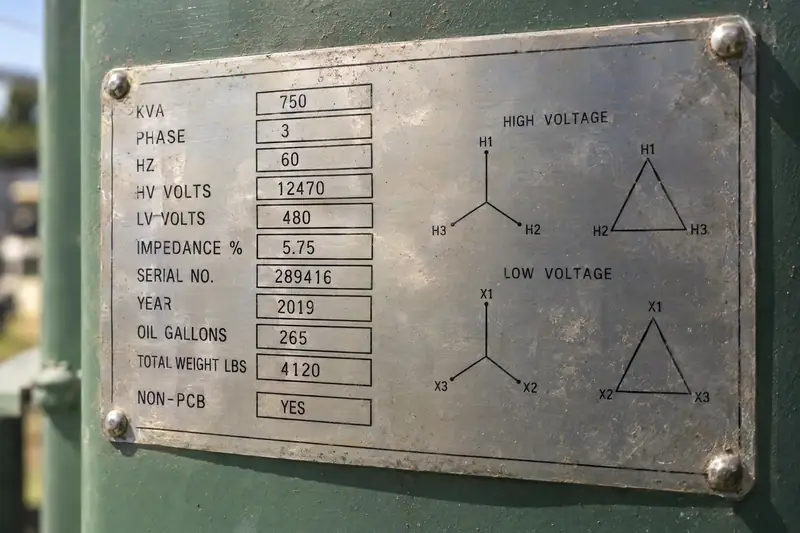
A transformer marked 112.5 kVA does not have one universal amp rating. Its full-load current depends on which winding you are reading, the rated voltage, and whether it is single-phase or three-phase. A high-voltage winding carries less current than a low-voltage winding for the same kVA rating.
Use this transformer kVA and full-load amps chart to cross-check a readable nameplate, not to guess an unknown unit's capacity from its cabinet size. We buy transformers across Virginia, and clear electrical ratings help us identify what you have. Our seller guides cover other equipment details that matter when describing a unit.
01What kVA and Full-Load Amps Actually Tell You
Kilovolt-amperes, abbreviated kVA, measure apparent power. A transformer's rated kVA describes its capacity under the operating conditions specified for that rating. Full-load amps are the current corresponding to rated kVA at a particular rated voltage; they are not necessarily the current flowing when someone takes a meter reading.
Kilowatts measure real power, so kVA and kW are not interchangeable. For an AC load, real power in kW equals apparent power in kVA multiplied by power factor. You do not insert the load's power factor into the formulas used here to calculate transformer rated full-load current.
For sellers, kVA is an identification field rather than a complete description of value or usability. We pay attention to phase, primary and secondary voltage, construction, condition, and other nameplate information alongside capacity. Two transformers with the same kVA can serve very different electrical systems.
Three-phase full-load amps chart
| Size | 208 V | 480 V | 600 V | 4,160 V | 12,470 V | 13,200 V | 13,800 V | 34,500 V |
|---|---|---|---|---|---|---|---|---|
| 15 kVA | 41.6 | 18 | 14.4 | 2.1 | 0.7 | 0.7 | 0.6 | 0.3 |
| 30 kVA | 83.3 | 36.1 | 28.9 | 4.2 | 1.4 | 1.3 | 1.3 | 0.5 |
| 45 kVA | 125 | 54.1 | 43.3 | 6.2 | 2.1 | 2 | 1.9 | 0.8 |
| 75 kVA | 208 | 90.2 | 72.2 | 10.4 | 3.5 | 3.3 | 3.1 | 1.3 |
| 112.5 kVA | 312 | 135 | 108 | 15.6 | 5.2 | 4.9 | 4.7 | 1.9 |
| 150 kVA | 416 | 180 | 144 | 20.8 | 6.9 | 6.6 | 6.3 | 2.5 |
| 225 kVA | 625 | 271 | 217 | 31.2 | 10.4 | 9.8 | 9.4 | 3.8 |
| 300 kVA | 833 | 361 | 289 | 41.6 | 13.9 | 13.1 | 12.6 | 5 |
| 500 kVA | 1,388 | 601 | 481 | 69.4 | 23.1 | 21.9 | 20.9 | 8.4 |
| 750 kVA | 2,082 | 902 | 722 | 104 | 34.7 | 32.8 | 31.4 | 12.6 |
| 1,000 kVA | 2,776 | 1,203 | 962 | 139 | 46.3 | 43.7 | 41.8 | 16.7 |
| 1,500 kVA | 4,164 | 1,804 | 1,443 | 208 | 69.4 | 65.6 | 62.8 | 25.1 |
| 2,000 kVA | 5,551 | 2,406 | 1,925 | 278 | 92.6 | 87.5 | 83.7 | 33.5 |
| 2,500 kVA | 6,939 | 3,007 | 2,406 | 347 | 116 | 109 | 105 | 41.8 |
| 3,000 kVA | 8,327 | 3,608 | 2,887 | 416 | 139 | 131 | 126 | 50.2 |
| 3,750 kVA | 10,409 | 4,511 | 3,608 | 520 | 174 | 164 | 157 | 62.8 |
| 5,000 kVA | 13,879 | 6,014 | 4,811 | 694 | 231 | 219 | 209 | 83.7 |
| 7.5 MVA | 20,818 | 9,021 | 7,217 | 1,041 | 347 | 328 | 314 | 126 |
| 10 MVA | 27,757 | 12,028 | 9,623 | 1,388 | 463 | 437 | 418 | 167 |
Single-phase full-load amps chart
| Size | 120 V | 240 V | 480 V | 7,200 V | 7,620 V | 14,400 V |
|---|---|---|---|---|---|---|
| 10 kVA | 83.3 | 41.7 | 20.8 | 1.4 | 1.3 | 0.7 |
| 15 kVA | 125 | 62.5 | 31.3 | 2.1 | 2 | 1 |
| 25 kVA | 208 | 104 | 52.1 | 3.5 | 3.3 | 1.7 |
| 37.5 kVA | 313 | 156 | 78.1 | 5.2 | 4.9 | 2.6 |
| 50 kVA | 417 | 208 | 104 | 6.9 | 6.6 | 3.5 |
| 75 kVA | 625 | 313 | 156 | 10.4 | 9.8 | 5.2 |
| 100 kVA | 833 | 417 | 208 | 13.9 | 13.1 | 6.9 |
| 167 kVA | 1,392 | 696 | 348 | 23.2 | 21.9 | 11.6 |
| 250 kVA | 2,083 | 1,042 | 521 | 34.7 | 32.8 | 17.4 |
| 333 kVA | 2,775 | 1,388 | 694 | 46.3 | 43.7 | 23.1 |
02Single-Phase Full-Load Current: Divide VA by Volts
For a single-phase transformer, full-load current in amperes equals kVA × 1,000 ÷ winding voltage. Multiplying by 1,000 converts kilovolt-amperes to volt-amperes. Use the rated voltage of the winding whose current you want to calculate, and keep primary and secondary calculations separate.
For example, a 25 kVA single-phase transformer with a 7,200 V primary and a 240 V secondary has a calculated primary full-load current of 25,000 ÷ 7,200 = 3.47 A. Its secondary full-load current is 25,000 ÷ 240 = 104.17 A. The different currents reflect the different winding voltages, not different transformer capacities.
A 120/240 V center-tapped secondary needs careful reading. For the full 240 V winding, use 240 V in the formula. Do not assume that dividing the entire transformer kVA by 120 V gives the allowable current on either individual 120 V leg; winding ratings and load balance matter.
03Three-Phase Full-Load Current: Use Line-to-Line Voltage
For a three-phase transformer, full-load line current in amperes equals kVA × 1,000 ÷ (√3 × line-to-line voltage). Use approximately 1.732 for √3. The kVA in this calculation is the total three-phase rating, not a per-phase rating.
A 112.5 kVA three-phase transformer rated 480 V has a calculated full-load line current of 112,500 ÷ (1.732 × 480), or about 135.3 A. At a 208 V winding, the same three-phase kVA corresponds to about 312.3 A. Our 112.5 kVA transformer page addresses selling equipment in that size.
On a 480Y/277 V nameplate, use 480 V for this three-phase line-current formula. The 277 V value is line-to-neutral voltage. Likewise, 12470GrdY/7200 identifies approximately 12,470 V line-to-line and 7,200 V line-to-neutral on a grounded-wye system; use 12,470 V when calculating three-phase line current.
The distinction also matters on larger equipment. A 1,500 kVA three-phase transformer calculates to about 1,804 A at 480 V and 69.45 A at 12,470 V. For MVA-class units, convert MVA to kVA first: 1.5 MVA equals 1,500 kVA. We buy power transformers as well as smaller distribution equipment.
04How to Read the Chart Below Without Mixing Ratings
Start with the nameplate's phase and kVA rating, then find the matching voltage in the chart below. Read the current for that exact combination. A 480 V single-phase entry and a 480 V three-phase entry will not give the same amperage at equal kVA.
Treat chart values as rounded calculated references. Small differences from a nameplate may reflect rounding, while larger differences call for checking the voltage, phase, rating basis, and selected winding. A tap position or a separately listed rating may explain why two numbers do not immediately match.
The transformer kVA and full-load amps chart is especially useful when a seller has copied a rating incorrectly. If the calculated current looks inconsistent, send a photograph rather than rewriting the plate from memory. Do not use the chart to choose protective devices, approve an installation, or determine how much overload a transformer can withstand.
- Confirm single-phase or three-phase before selecting an entry.
- Match the chart voltage to the winding being checked.
- Use line-to-line voltage for three-phase line current.
- Check whether the plate lists more than one kVA rating.
05Match the Calculation to the Actual Nameplate
A useful nameplate photo shows the manufacturer, serial number, kVA or MVA, phase, frequency, primary and secondary voltages, and winding connection. Include tap information and any listed amp ratings. Photograph the plate straight on, close enough to read, without cutting off the edges.
Cooling designations can explain multiple capacity ratings. ONAN indicates oil-natural, air-natural cooling; ONAF indicates oil-natural, air-forced cooling. When a plate lists separate ratings for those cooling modes, calculate current using the applicable rating rather than automatically selecting the largest number.
Construction and fluid details help identify the equipment but do not change the basic formulas. Photograph any fluid identification, such as mineral oil or FR3 natural ester, and disclose documented PCB status. Our pad-mount versus substation guide explains physical distinctions that an amperage calculation cannot establish.
06What Calculated Amps Cannot Prove About a Transformer
A full-load current calculation does not prove that a transformer works. It cannot establish insulation condition, winding integrity, fluid condition, or whether an accessory functions. It also does not show remaining service life or confirm that equipment is suitable for a proposed installation.
Likewise, measured operating current does not establish rated capacity. A transformer supplying a light load may carry far less than its full-load amps. Breaker ratings, cable sizes, cabinet dimensions, and total equipment weight are not substitutes for the transformer's own electrical rating.
We buy used, surplus, and new-surplus transformers, with failed or damaged units reviewed case by case. Include available test reports and explain known problems. Keep the stated nameplate capacity separate from claims about tested condition or operational history.
07Use the Ratings to Describe Your Transformer for Sale
A clear description might read: “112.5 kVA, three-phase, 480 V primary, 208Y/120 V secondary, dry-type,” followed by quantity and condition. Include all relevant rating lines if the plate shows alternate connections or cooling capacities. Say when a marking is unreadable instead of presenting a calculated estimate as a confirmed rating.
Send Virginia Transformer Buyers a clear nameplate photo, overall photos, location, quantity, and condition notes through request an offer. We review the information and may ask about PCB documentation, test data, or site access; if the equipment fits, we send a written offer specifying price, freight, loading, and payment terms, then schedule pickup with you. See how selling works for details.
Frequently asked questions
How many amps is a 75 kVA three-phase transformer at 480 volts?
A 75 kVA three-phase transformer has a calculated full-load line current of about 90.2 A at 480 V. The calculation is 75,000 ÷ (1.732 × 480). That figure applies to the 480 V winding at the stated rating; a different secondary voltage produces a different full-load current.
Can I calculate transformer kVA from a nameplate amp rating?
Yes, if you also know the winding voltage and phase configuration. For single-phase equipment, kVA equals volts × amps ÷ 1,000. For three-phase equipment, kVA equals 1.732 × line-to-line volts × line amps ÷ 1,000. Use rated nameplate current, not a casual measurement of current under an unknown load.
Do I use 480 or 277 volts for a 480Y/277 transformer?
Use 480 V when calculating total three-phase full-load line current. The 277 V marking describes line-to-neutral voltage, while 480 V describes line-to-line voltage. Inserting 277 V into the three-phase formula given on this page would overstate the calculated line current for that winding.
Why does my transformer have two kVA ratings?
Multiple kVA ratings may correspond to different cooling modes or other operating conditions specified on the nameplate. For example, an oil-filled transformer may list an ONAN rating and a higher ONAF rating requiring forced-air cooling. Read the labels attached to each rating before selecting a chart entry or describing the unit for sale.
Can this chart tell me what breaker size a transformer needs?
No, this chart calculates rated full-load current, not the required breaker size. Protective-device selection depends on installation details, applicable electrical rules, inrush, and protection coordination. Virginia Transformer Buyers does not provide engineering advice or electrical disconnect work; sellers use their own qualified electricians to de-energize and disconnect equipment.
Can I identify an unreadable transformer from its voltage and cabinet size?
Voltage and cabinet size alone cannot reliably establish transformer kVA. Different capacities and designs can have similar enclosures, and voltage does not specify available current. Send any surviving nameplate markings, manufacturer documents, and overall photos, clearly identifying missing information. Do not substitute a chart-derived guess for a verified equipment rating.