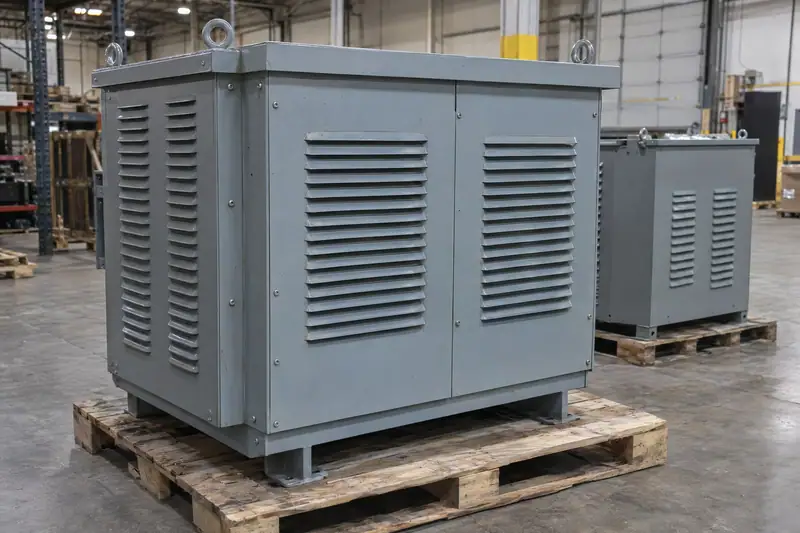
A 112.5 kVA three-phase transformer commonly serves commercial buildings, restaurants and light manufacturing. It may supply lower-voltage distribution from a building’s 480-volt system or step utility distribution voltage down through a pad-mount installation. The rating alone does not tell us which application your unit served; its primary voltage, secondary voltage and construction do.
We buy 112.5 kVA units from sellers throughout Virginia, whether the equipment is unused surplus, removed from service or still awaiting qualified electrical disconnection. If you want to sell 112.5 kVA transformer equipment, start with the actual nameplate rather than an estimate based on cabinet dimensions. Our transformer size guide helps distinguish this rating from neighboring sizes.
01What the 112.5 kVA Rating Means
The 112.5 kVA rating describes a transformer’s apparent-power capacity under its specified operating conditions. On a three-phase unit, that figure is the total rating across all three phases, not 112.5 kVA per phase. It is also not automatically 112.5 kW of usable real power; the relationship between kVA and kW depends on load power factor.
For balanced three-phase full-load current, use amps = kVA × 1,000 ÷ (√3 × line-to-line volts). One example is a 112.5 kVA secondary rated 480 volts: 112,500 ÷ (√3 × 480) gives approximately 135.3 amps. Use the amp table on this page for other voltage combinations, or see the kVA and full-load amps guide. These figures describe rated current, not the building’s actual demand or a recommended breaker size.
02Voltage Combinations That Identify the Application
A familiar dry-type configuration at this size is a 480-volt primary with a 208Y/120-volt secondary. The secondary provides 208 volts line to line and 120 volts line to neutral when installed for that purpose. Commercial and restaurant installations may use this arrangement for mixed equipment and general building loads. Other configurations exist, so do not assume the voltage from the kVA rating.
Three-phase pad-mount units can have medium-voltage primaries, such as 12470GrdY/7200, with low-voltage secondaries such as 208Y/120 or 480Y/277. Copy the complete voltage notation, including delta or grounded-wye markings. Primary taps, frequency and the connection diagram also matter: two transformers with the same 112.5 kVA rating are not necessarily interchangeable.
- Primary and secondary rated voltages, exactly as printed
- Three-phase designation and rated frequency
- Available tap positions and the marked connection diagram
- Impedance percentage and winding material, if identified
Full-load amps for a 112.5 kVA three-phase transformer
The amp table on this page uses the standard formula Amps = kVA × 1,000 ÷ (1.732 × line-to-line volts). Match the voltage on your nameplate to read the rated full-load current of each winding.
| Winding voltage | Full-load amps |
|---|---|
| 208 V | 312 |
| 240 V | 271 |
| 480 V | 135 |
| 600 V | 108 |
| 2,400 V | 27.1 |
| 4,160 V | 15.6 |
| 12,470 V | 5.2 |
| 13,200 V | 4.9 |
| 13,800 V | 4.7 |
| 23,000 V | 2.8 |
| 34,500 V | 1.9 |
03Dry-Type and Pad-Mount Units at 112.5 kVA
We buy three-phase dry-type transformers rated 112.5 kVA, including equipment from electrical rooms, tenant renovations and industrial distribution systems. Ventilated dry-type units rely on airflow around their windings. Enclosure condition, blocked ventilation, visible overheating and missing covers are useful condition details. Temperature rise, insulation class and enclosure markings help describe the unit more accurately than a photo of the exterior alone.
We also buy three-phase pad-mount transformers at this rating. For liquid-filled units, tell us the fluid type if documented, whether leaks are present, and whether the cabinet and terminal compartments are intact. Mineral oil and FR3 natural ester are different insulating fluids; neither label replaces PCB documentation. Disclose and document PCB status, and do not drain fluid to prepare equipment for sale.
04Confirm the Rating and Document the Condition
Find the manufacturer’s nameplate and photograph the entire plate straight on, with enough detail to read the smaller fields. Look for “112.5 kVA,” “3 PH” or an equivalent three-phase designation, rated voltages, model and serial number. The nameplate is stronger identification than a handwritten inventory tag, electrical-room label or old purchase description.
We pay attention to whether the plate describes the complete transformer and whether the equipment matches it. Include overall views, enclosure damage, corrosion and any accessories or loose parts included in the sale. Photograph visible terminals only where safely accessible; do not open energized compartments for photos. Existing test reports and maintenance records can clarify condition, but a clean exterior alone does not establish electrical health.
05Physical Size, Weight and Removal Access
There is no single cabinet size or weight for every 112.5 kVA transformer. Construction, winding material, enclosure design, temperature-rise design and liquid-filled versus dry-type construction affect the dimensions and mass. Use the marked weight or manufacturer’s documentation when available. If those are missing, send measured height, width and depth rather than treating a similar-looking unit as an exact match.
Access can be especially important for a transformer in a basement electrical room, restaurant service area or crowded manufacturing space. Tell us about door openings, stairs, loading docks, outdoor ground conditions and whether suitable loading equipment is available. Photos of the route out help explain restrictions. Sellers must use their own qualified electricians to de-energize and disconnect equipment; we do not perform electrical disconnect work.
06What Makes a 112.5 kVA Unit a Useful Purchase
Demand for a particular 112.5 kVA transformer depends on its usable configuration, not just its rating. Familiar commercial voltages can suit building distribution applications, while less common voltages may serve a narrower requirement. Complete identification, sound condition and documented operating history help explain what is available. A 75 kVA transformer or a 150 kVA transformer is a different capacity, not a direct substitute selected by enclosure size.
To sell 112.5 kVA transformer equipment, send clear nameplate and overall photos, location, quantity and condition notes through our offer request form. We review the information and may ask about PCB status, test data or site access. If the equipment fits, we send a written offer specifying price, freight, loading and payment terms; pickup is scheduled with you and payment follows those terms. See how the purchase process works for details.
Frequently asked questions
Is a 112.5 kVA three-phase transformer rated 112.5 kVA per phase?
No, 112.5 kVA is the total three-phase rating, not the capacity of each phase. Read the phase designation and rating together on the nameplate. If your inventory consists of separate single-phase transformers connected as a bank, send each unit’s nameplate and explain the arrangement rather than describing every unit as a 112.5 kVA three-phase transformer.
Do you buy 112.5 kVA transformers with 480 to 208Y/120 volts?
Yes, we buy 112.5 kVA three-phase transformers with a 480-volt primary and 208Y/120-volt secondary. Send the connection diagram along with the voltage fields so we can identify the configuration accurately. Include tap information, condition and any existing test records; matching voltages alone do not describe the transformer’s complete condition or construction.
Can I sell a 112.5 kVA transformer removed during a restaurant remodel?
Yes, we buy used and decommissioned 112.5 kVA transformers removed during restaurant remodels. Tell us whether it was operating before removal, whether covers and terminals are complete, and where it is now stored. If it remains connected, your qualified electrician must handle de-energizing and disconnection; we do not perform that work.
How much does a 112.5 kVA dry-type transformer weigh?
The weight varies by manufacturer and design, so the 112.5 kVA rating alone is not enough to give a reliable weight. Check the nameplate, shipping label or manufacturer’s model documentation. Send any marked weight plus enclosure dimensions and access photos so loading requirements can be addressed without relying on a generic estimate.
Will you buy a failed 112.5 kVA transformer?
Failed 112.5 kVA transformers are reviewed case by case. Describe the failure, including known overheating, winding damage, fluid leaks or test findings, and send photos of visible damage. Do not describe a failed unit as working surplus. For liquid-filled equipment, PCB status must be disclosed and documented, and sellers should not drain the fluid.
Can you identify my 112.5 kVA transformer if the nameplate is unreadable?
An unreadable nameplate makes identification harder, but supporting documentation may establish the rating and configuration. Send partial plate photos, model markings, purchase records or a manufacturer’s drawing tied to that specific unit. Cabinet dimensions and a breaker label do not reliably prove a 112.5 kVA rating, so make clear which details remain unknown.