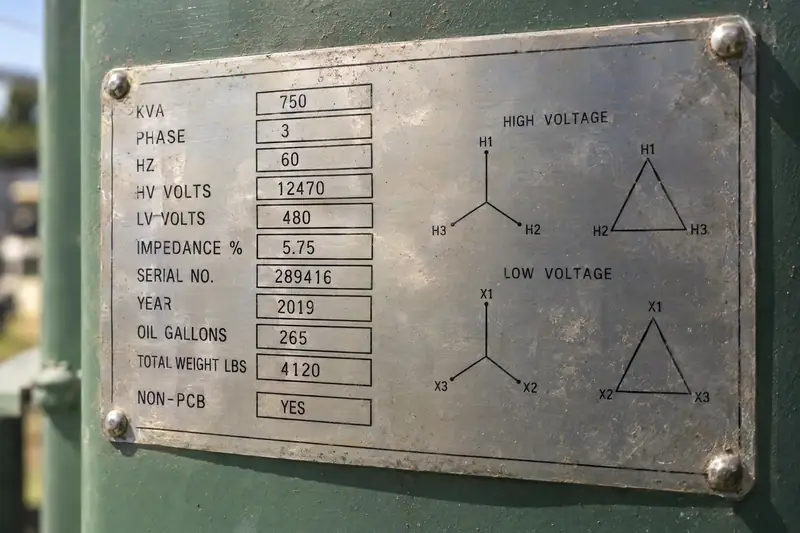
A transformer nameplate describes the unit’s rated electrical and thermal characteristics. It does not prove present condition, confirm the active tap position or replace test records. When selling, the goal is to capture the ratings accurately and identify anything the plate leaves unanswered.
This guide explains how to read a transformer nameplate from a buyer’s perspective, including fields that can change an equipment match. We buy all brands and sizes within our buying range, but a brand name alone tells us little about voltage compatibility, capacity or handling requirements. For the broader value picture, see what affects a used transformer’s worth.
011. Start with kVA, phase and frequency
kVA is the transformer’s apparent-power rating, not its weight or a direct statement of usable kilowatts. A 500 kVA unit and a 500 kW load are not automatically equivalent because load power factor matters. We use kVA to establish capacity and compare the transformer with potential applications.
Phase and frequency are separate fields. Look for single-phase or three-phase and a frequency such as 60 Hz. A transformer designed for another frequency is not automatically interchangeable with a 60 Hz unit at the same voltage. Photograph every rating listed, especially when a power transformer shows multiple capacities tied to cooling stages.
- Record the exact kVA or MVA rating; 1 MVA equals 1,000 kVA.
- Include all ratings on a multi-rating plate, not just the largest number.
- Capture phase and Hz even when you believe they are obvious from the installation.
022. Read HV/LV voltages and winding connections together
HV and LV identify the high- and low-voltage windings. Read the complete notation rather than shortening it to “12 kV” or “480 volts.” For example, 12470GrdY/7200 describes a grounded-wye rating with 12,470 volts line-to-line and 7,200 volts line-to-neutral. A 480Y/277 secondary similarly identifies 480 volts line-to-line and 277 volts line-to-neutral.
Connection diagrams show delta, wye, neutral points and terminal relationships. H and X terminal markings commonly identify high- and low-voltage terminals, but the unit’s diagram controls interpretation. We pay attention to both voltage and connection because matching one does not guarantee matching the other. See our transformer voltage ratings explanation for more examples.
- Photograph the connection diagram and any vector-group designation.
- Include series/parallel or dual-voltage instructions when shown.
- Do not infer an available neutral from the voltage number alone.
033. Find BIL, impedance percentage and tap ratings
BIL means basic lightning impulse insulation level and is normally expressed in kV. It describes an insulation withstand rating, not the transformer’s normal operating voltage. Different windings may have different BIL values. We need the winding-specific entries because equipment with similar operating voltages can have different insulation ratings.
Impedance, often marked Z or % impedance, affects voltage regulation and available fault current. Record its stated rating basis if shown. Taps provide specified winding-ratio adjustments; capture their voltages, percentages and diagram. A nameplate may list possible tap positions without identifying the position currently selected. Never operate a tap switch just to complete a sales inquiry.
- Include the impedance percentage and any associated kVA or temperature reference.
- Distinguish de-energized tap provisions from a load tap changer.
- Send an existing tap-position indication only if it can be photographed safely.
044. Match temperature rise to the cooling class
Temperature rise is a rated increase above the specified ambient reference under stated conditions. It is not the maximum temperature you should expect to read on a gauge. Liquid-filled units may show a 55°C or 65°C winding-rise rating; dry-type plates may show winding rise and insulation-system class separately. Those are related specifications, not interchangeable labels.
Cooling class explains how heat is removed and may explain multiple kVA ratings. ONAN means oil natural, air natural; ONAF means oil natural, air forced. Older plates may use OA and FA designations. We read cooling codes alongside capacity because a higher fan-assisted rating depends on the specified cooling arrangement. Photos should show whether listed fans or cooling equipment remain with the transformer.
| Marking | Meaning | Buyer-relevant detail |
|---|---|---|
| ONAN | Oil natural, air natural | Record the capacity assigned to this cooling stage. |
| ONAF | Oil natural, air forced | Capture the fan-assisted rating and photograph installed fans. |
| AA / AN | Air-cooled dry-type designations | Record the exact designation and associated capacity. |
055. Identify fluid type, gallons and PCB documentation
A liquid-filled plate may identify mineral oil, natural ester or another insulating fluid and list volume in gallons or liters. FR3 is a natural ester insulating fluid. Copy the fluid designation exactly and include separate fill or replacement labels. Nameplate volume describes the specified quantity; it does not confirm the present fluid level or whether the original fluid remains.
PCB status must be disclosed and documented. Photograph every PCB-related label and provide available fluid test records or other supporting documentation. Age, fluid color and a mineral-oil designation alone do not establish PCB status. We do not ask sellers to drain fluid. Our guide to PCB information for sellers explains what information to gather.
- Include fluid type, stated volume and any fluid-change label.
- Photograph PCB wording completely, including dates or concentration entries.
- State plainly when PCB status or fluid history is unknown.
066. Capture weights, serial number and manufacturing year
Weight entries may distinguish total weight, untanking weight, core-and-coil weight or fluid weight. These are not substitutes for one another. We use clearly labeled weights when discussing freight and loading terms. If only one weight appears, photograph its label and units rather than describing it as a shipping weight without confirmation.
Serial number, manufacturer, model or type, and manufacturing year connect the ratings to the specific unit. Serial numbers are especially important when several transformers look alike. Photograph any standards references, such as an IEEE C57 designation, but do not treat a standards marking as proof of present condition. Keep each unit’s nameplate photos paired with its overall photos.
- Do not infer a manufacturing year from an unfamiliar serial-number format.
- Identify missing accessories separately from the plate’s original configuration.
- Note replacement plates or conflicting labels instead of choosing one silently.
077. Photograph the nameplate so every field is readable
Knowing how to read a transformer nameplate helps only if the photograph preserves the details. Take one straight-on image of the complete plate, then close-ups of small lettering and diagrams. Use even light, avoid flash glare and check focus before leaving. Keep the original-resolution files; screenshots and messaging compression can erase decimal points and serial-number characters.
Send us the nameplate, overall photos, location, quantity and condition notes through the offer request form. We review the information and may ask about PCB documentation, test data or access; if the equipment fits, our written offer specifies price, freight, loading and payment terms, with pickup scheduled together and payment following those terms. See the selling process for details.
- Take an overall photo that clearly identifies the unit associated with the plate.
- Photograph separate connection, fluid, PCB and accessory labels.
- Do not open energized compartments or reach past barriers for a photo.
- Use your own qualified electrician for de-energizing and disconnecting; we do not perform electrical disconnect work.
Frequently asked questions
Can I sell a transformer if the nameplate is missing?
A missing nameplate does not automatically rule out a sale, but it leaves important identification gaps. Send Virginia Transformer Buyers overall photos, remaining labels and existing records that identify ratings and the specific unit. Do not guess kVA or voltage from cabinet size. We may need additional documentation before we can establish whether the equipment fits.
Why does my transformer nameplate show two or three kVA ratings?
Multiple kVA ratings often correspond to different cooling stages, though the plate may also distinguish temperature-rise ratings. Read each capacity with its associated cooling code and notes. For example, an ONAN/ONAF unit can show natural-cooling and fan-assisted capacities. Photograph the full rating block and installed cooling equipment rather than reporting only the highest capacity.
Is transformer impedance percentage the same as efficiency?
No, transformer impedance percentage is not an efficiency rating. It describes the transformer’s impedance on a specified rating basis and is relevant to voltage drop and fault-current calculations. Efficiency concerns losses relative to power output. Send the impedance entry exactly as printed, including any reference temperature or capacity, rather than converting it into an efficiency estimate.
Does a transformer nameplate tell me whether it contains PCBs?
A nameplate alone may not establish PCB status; separate labels and supporting documentation may be necessary. Photograph all PCB-related markings and provide available fluid test records or other documentation. Virginia Transformer Buyers requires PCB status to be disclosed and documented. Do not assume that manufacturing year, fluid appearance or an oil-type entry proves the current PCB status.
What should I send if my transformer plate is faded or unreadable?
Send several original-resolution photos under different lighting, plus any existing records tied to the unit’s serial number. A straight-on view and a slightly angled view can reveal different stamped characters. Avoid scraping, solvents or removing the plate. Include readable accessory labels and overall photos, and clearly identify which fields you cannot confirm.
Is a cast resin transformer’s insulation class its temperature rise?
No, insulation-system class and winding temperature rise are different specifications. Insulation class identifies the thermal classification of the insulation system, while rated rise describes temperature increase under specified conditions. For a cast resin unit, capture both entries, cooling designation and kVA. Our cast resin transformer buying page covers that equipment type.