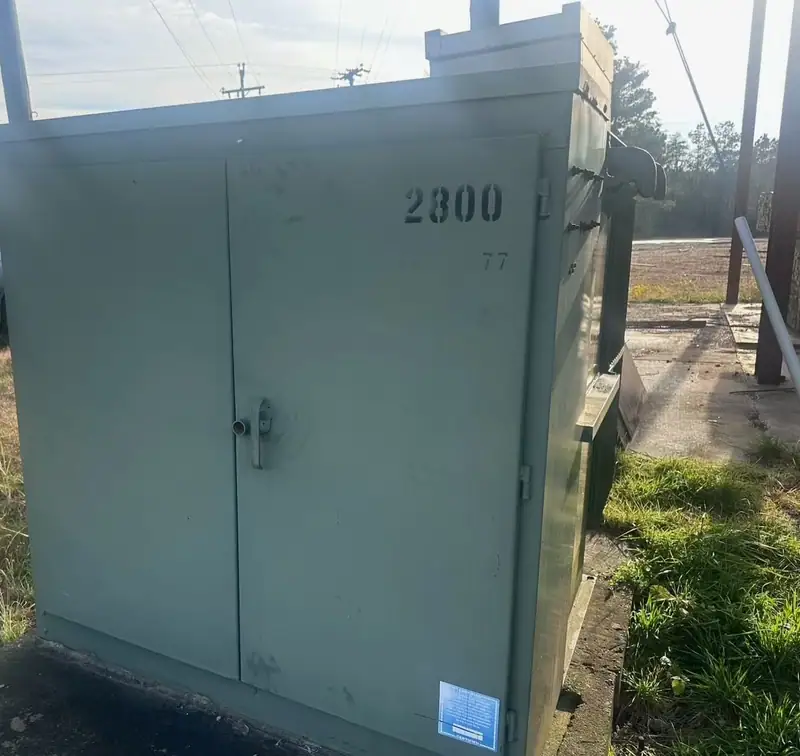
A transformer marked 12470GrdY/7200 is not simply a “7,200-volt transformer.” That notation describes a grounded-wye system with 12,470 volts between phases and approximately 7,200 volts from phase to neutral. Whether the equipment is a single-phase pole unit or a three-phase pad-mount matters when interpreting its actual winding connections.
This guide keeps transformer voltage ratings explained in terms sellers can use: what the nameplate says, which numbers belong together and what affects a buyer’s application. For help locating the voltage diagram, tap schedule and connection details, use our transformer nameplate guide. Never open energized compartments to obtain information.
01Primary and secondary ratings describe different sides
On a typical distribution transformer, the primary is the higher-voltage supply side and the secondary supplies the lower-voltage load. Common US distribution primary ratings include 4.16, 12.47, 13.2, 13.8, 23 and 34.5 kV. These ratings are not interchangeable merely because two transformers have matching kVA capacity or similar cabinets.
We buy all brands and sizes within our buying range, but we pay attention to the complete voltage designation. A 13,200-volt primary is not automatically suitable for a 12,470-volt circuit. Tap range, connections, insulation requirements and the intended system all matter. Equipment suitability must be established by the seller’s or end user’s qualified professionals, not inferred from a nearby number.
| Nameplate marking | Typical interpretation | Detail to preserve in photos |
|---|---|---|
| 4160, 13200, 13800 or 23000 V | A winding voltage rating; the connection diagram identifies how it applies | Delta or wye connection and tap schedule |
| 12470GrdY/7200 | 12,470 V line-to-line and about 7,200 V line-to-neutral on a grounded-wye system | Phase count and actual winding connection |
| 34500GrdY/19920 | 34,500 V line-to-line and about 19,920 V line-to-neutral | Grounding designation and primary BIL |
| 208Y/120 or 480Y/277 | Wye secondary with both line-to-line and line-to-neutral ratings | Neutral terminal and secondary diagram |
02Read secondary voltages as a connection, not a list
On a three-phase 208Y/120 secondary, 208 volts is measured between phases and 120 volts between a phase and neutral. The same relationship gives 480 volts between phases and 277 volts to neutral on a 480Y/277 secondary. For a balanced wye system, line-to-line voltage is approximately 1.732 times line-to-neutral voltage.
A 240-volt delta secondary normally identifies 240 volts between phases; it does not by itself promise a usable neutral. A center-tapped 240-volt delta can provide 120-volt circuits, but its high leg is approximately 208 volts to neutral. A single-phase 120/240 secondary is different: two 120-volt sections provide 240 volts across the outside terminals. Preserve the diagram rather than describing every one of these as “240 output.”
03Delta, wye and grounded wye affect compatibility
Delta connects three winding sections in a closed triangle. Wye connects one end of each section to a common point, which may be brought out as a neutral. Grounded wye indicates that the neutral point is grounded in the intended arrangement. Connection type affects available voltages, grounding and phase relationships, so equal voltage numbers do not establish an equivalent replacement.
For a single-phase unit labeled 12470GrdY/7200, the transformer may have a 7,200-volt winding intended for phase-to-neutral service on a 12,470-volt grounded-wye system. For a three-phase unit, the same notation describes the system relationship across all three phases. We need the phase designation, terminal diagram and voltage text together, whether you are selling a pole-mount, pad-mount or dry-type transformer.
04Dual-voltage primaries are not ordinary taps
A marking such as 12470GrdY/7200 x 24940GrdY/14400 generally identifies two primary operating configurations. The “x” separates alternatives; it does not mean the transformer simultaneously accepts both supply voltages. Depending on the design, a selector or prescribed winding reconnection changes the primary arrangement. The nameplate and manufacturer’s connection instructions identify the permitted configurations.
Record both ratings and any externally visible selector indication without operating equipment. A dual-primary unit may suit more applications than a comparable single-voltage unit, but buyers still need the correct secondary, kVA, connections and insulation rating. Do not assume that every transformer with multiple voltage numbers is dual-voltage: some numbers describe wye relationships, while others are tap positions.
We also want to know whether the selector condition or winding configuration is uncertain. Missing diagrams and unreadable markings make matching equipment harder. For other construction differences that matter alongside voltage, see dry-type versus oil-filled equipment.
05Taps adjust the ratio within a defined range
Primary taps change the effective number of winding turns, allowing adjustment of the transformation ratio. A common schedule provides two 2.5% steps above and two below nominal, but schedules vary. Read the actual voltage list and tap designation. A tap range intended for modest supply variation is not equivalent to a dual-voltage primary.
Many distribution transformers use de-energized tap changers, which must not be operated while energized. Some larger transformers have load tap changers designed for adjustment under load. Report the type and any documented position, but leave verification and operation to qualified personnel. We do not perform electrical disconnect work; sellers use their own qualified electricians to de-energize and disconnect.
06BIL is an insulation rating, not operating voltage
Basic impulse insulation level, or BIL, describes insulation withstand capability for a specified impulse test, expressed in kilovolts crest. It is not the normal supply voltage and does not authorize operation at that voltage. For example, a 95 kV BIL marking is not a 95 kV primary rating.
Primary and secondary windings can have different BIL ratings. Buyers use those ratings alongside nominal voltage, terminals and applicable equipment specifications to check compatibility. IEEE C57 standards address transformer requirements and testing, but a standards reference alone does not establish condition or suitability. Send legible BIL markings and any available test reports; keep insulation information separate from the operating-voltage description.
07Why voltage affects resale demand in Virginia
Dominion and Virginia electric cooperative systems widely use 12.47 kV and 34.5 kV class distribution, although actual circuits and specifications vary. Equipment compatible with those systems can match a broader set of local applications than an unusual voltage combination. That does not guarantee an offer: secondary voltage, kVA, connections, condition and installation requirements still affect demand.
A 480Y/277 secondary serves different loads from a 208Y/120 secondary, even with identical primary ratings. Industrial transformers with 4.16 or 13.8 kV ratings may match plant distribution rather than a utility service application. We serve every Virginia region and review equipment in neighboring states and nationwide on request. Our guide to transformer value explains the other factors beyond voltage.
Send a clear nameplate photo, overall photos, location, quantity and condition notes through the offer form. We review the information and may ask about PCB documentation, test data or site access; PCB status must be disclosed and documented. If the equipment fits, our written offer states price, freight, loading and payment terms; pickup is scheduled with you and payment follows those terms. See how selling works for details.
Frequently asked questions
Is 12470GrdY/7200 a 12,470-volt or 7,200-volt transformer?
The marking describes both voltages in a grounded-wye system: 12,470 volts between phases and approximately 7,200 volts from phase to neutral. A single-phase transformer may have a 7,200-volt primary winding for that system. A three-phase transformer has a different winding arrangement, so include the phase count and connection diagram when describing it.
Can a 13.2 kV transformer be used on a 12.47 kV supply?
The voltage labels alone do not establish compatibility. A qualified professional must check the tap schedule, intended secondary voltage, connections and system requirements. A suitable primary tap may accommodate the supply difference on some equipment, but do not advertise interchangeability without supporting specifications. Send the full tap schedule with the main voltage rating.
Does 480Y/277 mean I can choose either output voltage?
No, 480Y/277 describes two voltage measurements on the same wye secondary, not two selectable configurations. It provides 480 volts between phases and 277 volts from phase to neutral when connected as specified. Using line-to-neutral loads requires the appropriate neutral arrangement and installation; the connection diagram is essential.
Does a higher BIL make my transformer worth more?
A higher BIL does not automatically increase resale value. It may satisfy an application’s insulation requirement, but buyers also need compatible operating voltages, kVA, connections and condition. BIL is an impulse withstand rating, not additional output capacity. Keep the BIL designation visible in the nameplate photo rather than treating it as the primary voltage.
Can I sell a transformer if its voltage label is unreadable?
You can submit equipment with an unreadable voltage label, but missing ratings make application matching harder. Send overall photos, any readable serial or model numbers, terminal diagrams and existing records. Do not guess the voltage from cabinet size or bushings. Virginia Transformer Buyers may ask for additional documentation before determining whether the equipment fits.