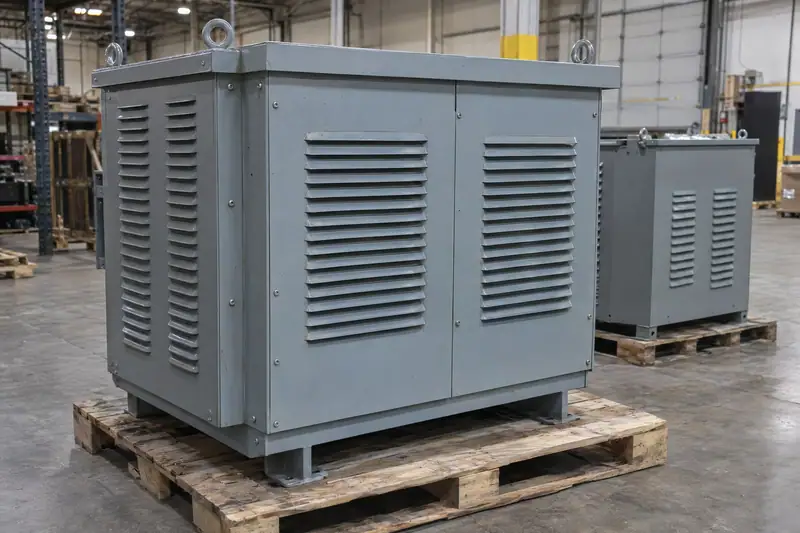
A dry-type transformer from an indoor electrical room and an oil-filled transformer from a utility yard may have the same kVA rating but serve different replacement needs. Their enclosures, cooling arrangements, voltage classes and installation requirements affect where another owner can use them. Those differences also affect what information we need from a seller.
This guide compares dry-type vs oil-filled transformers from a seller’s perspective, including maintenance records, fire considerations, service life and surplus value. Start with the equipment itself rather than its nickname: our transformer nameplate guide explains the fields that distinguish one unit from another.
01Construction: Air and Solid Insulation vs Insulating Liquid
Dry-type transformers do not immerse their core and coils in insulating liquid. Common designs include ventilated windings with varnish or resin-based insulation, vacuum-pressure-impregnated windings and cast-resin coils. Enclosures can differ substantially, so an indoor ventilated unit should not be described as suitable for outdoor service without checking its enclosure rating.
Oil-filled transformers place the active assembly in a tank containing insulating liquid, commonly mineral oil. Other liquid-filled units use natural ester fluids, including FR3, or other specified fluids. Record the actual fluid designation rather than calling every liquid-filled unit a mineral-oil transformer. Tank construction, radiators, bushings and cooling equipment help identify the configuration.
| Feature | Dry-type | Oil-filled or other liquid-filled |
|---|---|---|
| Insulating system | Solid insulation with air around the assembly | Solid insulation combined with insulating liquid |
| Cooling equipment | Natural air circulation or forced-air fans | Tank surfaces, radiators and sometimes fans or pumps |
| Useful condition photos | Coils, supports, terminals and enclosure interior | Tank, bushings, radiators, gauges and any leaks |
| Additional documentation | Insulation tests and inspection records, if available | Fluid identity, PCB documentation and oil test reports, if available |
02Applications and Size Ranges Overlap
Dry-type units are common in commercial buildings, industrial facilities and indoor distribution systems. Oil-filled units are common in outdoor pad-mount, pole-mount, substation and power-transformer applications. These are typical uses, not absolute boundaries: appropriately designed dry-type equipment can serve outdoor applications, and liquid-filled installations can be indoors when applicable requirements are met.
We buy all brands and sizes, including single-phase transformers from 10 kVA and three-phase transformers from 15 kVA through MVA-class equipment. At larger ratings, liquid-filled construction is common, but kVA alone does not establish the design. A 5,000 kVA transformer, for example, still needs voltage, cooling and construction details before it can be matched to a replacement application.
- Identify whether the unit is standalone, pad-mounted or part of a unit substation.
- Record primary and secondary voltages exactly as shown.
- Include winding connections, frequency and impedance.
- Photograph attached switches, terminal chambers and bus connections.
03Efficiency Depends on the Design, Not Just the Cooling Medium
There is no reliable blanket rule that every oil-filled transformer is more efficient than every dry-type transformer. Core material, winding design, load level, operating temperature and manufacturing requirements all affect losses. No-load losses occur while the transformer is energized; load losses increase with current and include winding losses and other load-related losses.
For surplus equipment, factory loss data and test reports are more useful than a general efficiency claim. Rated kVA also needs context: a transformer may carry different ratings with natural cooling and with fans operating. On liquid-filled power transformers, ONAN and ONAF identify different cooling arrangements; verify that the equipment supporting each stated rating is present.
04Fire Codes and Installation Requirements Affect Reuse
Dry-type equipment avoids a tank of insulating liquid, but it is not automatically free of fire or installation restrictions. Ventilation, clearances, enclosure suitability and protection remain important. Liquid-filled installations can require provisions addressing fluid combustibility, separation and containment, depending on the fluid, location and applicable codes.
Natural ester fluids generally have higher fire points than conventional mineral insulating oil, but fluid type alone does not establish installation approval. A prospective installer needs to verify the transformer’s listing, construction and applicable requirements. We do not provide engineering, legal or environmental advice; sellers should keep drawings and fluid documentation available rather than labeling a unit universally “indoor approved.”
05Maintenance Records Show Different Kinds of Condition
For dry-type equipment, we pay attention to dust buildup, moisture exposure, damaged insulation, discoloration, loose supports and the condition of terminals and fans. Cast-resin coils should be photographed clearly if cracks or damage are visible. A clean exterior does not establish electrical condition, and cleaning does not reverse insulation damage.
For liquid-filled equipment, useful records include inspections, leak history, fluid level observations and available laboratory reports. Moisture, dielectric breakdown testing and dissolved gas analysis provide different information; no single result proves overall condition. Our transformer oil testing guide explains these distinctions. PCB status must be disclosed and documented, and we do not ask sellers to drain fluid.
- State whether the transformer was operating when removed.
- Disclose known trips, faults, overheating or water exposure.
- Keep test dates attached to the corresponding reports.
- Photograph missing components rather than assuming they are minor.
06Lifespan and Surplus Value Depend on History and Fit
Neither construction type has a fixed service life that can be determined from age alone. Heat, loading, moisture, contamination and maintenance affect insulation aging. Dry-type units stored in damp conditions and liquid-filled units with compromised seals deserve particular attention. A manufacturing date is useful, but it does not replace operating history or condition records.
When comparing dry-type vs oil-filled transformers for resale, we pay attention to usable ratings, condition, completeness and the practical cost of moving the equipment. A documented standard configuration may fit a replacement need more readily than an unusual voltage combination. New-surplus transformers also need storage history: unused equipment can still have corrosion, moisture exposure or missing accessories.
- kVA or MVA capacity and each stated cooling rating
- Primary and secondary voltages, taps and winding connections
- Impedance, frequency and available test documentation
- Enclosure, terminals, bushings and accessory completeness
- Dimensions, weight and loading access
- Known damage, fluid identity and documented PCB status for liquid-filled units
07Describe the Actual Unit Before Requesting an Offer
A description such as “480-volt transformer” leaves important questions unanswered. A primary marked 12470GrdY/7200 and a secondary marked 480Y/277 describe specific system voltages and connections, not interchangeable labels. Use the voltage ratings guide to understand the notation, and send the complete nameplate rather than a typed summary.
Send clear nameplate and overall photos, location, quantity and condition notes through our offer form. We review the information and may ask about tests, PCB status or access; if the equipment fits, our written offer specifies price, freight, loading and payment terms, with pickup scheduled together. See how the buying process works for details. Your qualified electrician must de-energize and disconnect the equipment; we do not perform electrical disconnect work.
Frequently asked questions
Are dry-type transformers worth more than oil-filled transformers?
Dry-type transformers are not automatically worth more than oil-filled transformers. Virginia Transformer Buyers pays attention to the specific unit’s capacity, voltages, condition, completeness, documentation and handling requirements. Construction type helps define the potential application, but it does not establish a universal value ranking. Two units with the same kVA can have very different replacement uses.
Can I sell a cast-resin transformer with cracked coils?
Virginia Transformer Buyers reviews cast-resin transformers with cracked coils case by case as damaged equipment. Disclose the cracks and provide clear photos showing their location and extent, along with the nameplate and any failure history. Do not describe the unit as serviceable based only on its appearance or a previous operating record.
Does FR3 fluid make a transformer dry-type?
No, a transformer filled with FR3 natural ester is liquid-filled, not dry-type. The distinction concerns the insulating and cooling construction, not whether the liquid is conventional mineral oil. Include the fluid designation and supporting records when selling. PCB status must still be disclosed and documented rather than inferred solely from a fluid label.
Which transformer type usually takes up less space?
There is no universal footprint winner across all ratings and configurations. Compare actual dimensions, including enclosures, radiators and terminal compartments, rather than kVA alone. Installed space also includes required access, ventilation and clearances. For a surplus offer, send shipping dimensions and weight separately from any available installation drawings.
Can I sell an oil-filled transformer without oil test results?
You can submit an oil-filled transformer for review without oil test results, but identify which records are unavailable. Virginia Transformer Buyers may ask additional questions about operating history, fluid condition and known problems. PCB status must be disclosed and documented. Missing test data should never be presented as evidence that the fluid or transformer is in good condition.
Do cooling fans change the kVA rating I should report?
Cooling fans can support an additional nameplate rating, so report every rating and its associated cooling designation. Do not advertise only the highest kVA if the required fans or controls are missing. Photograph the cooling equipment and disclose whether it is complete. The nameplate, rather than an estimate based on physical size, should establish the stated capacities.