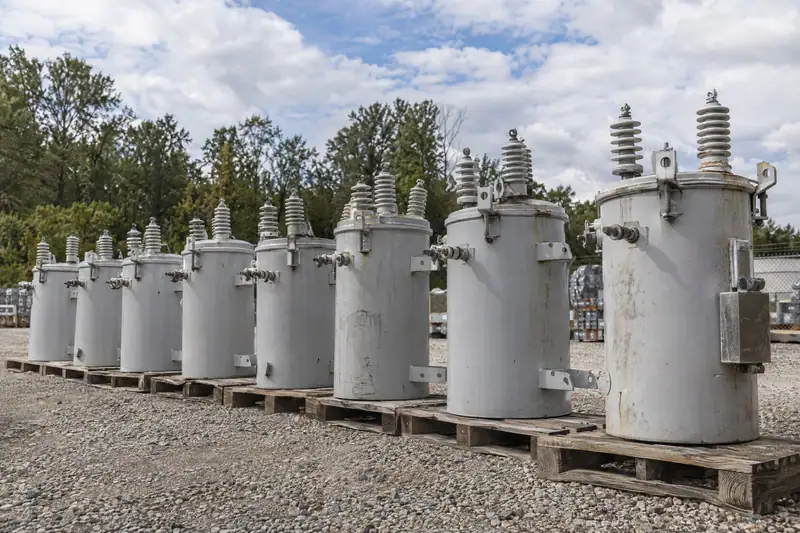
Howard Industries transformers appear in utility stock, cooperative inventories, contractor storage, and retired distribution equipment. Howard Industries is headquartered in Laurel, Mississippi, and is one of the largest builders of utility distribution transformers in the United States. Its pole-mount and pad-mount units are widely stocked by utilities, cooperatives, and electrical contractors.
If you want to sell Howard Industries transformer inventory in Virginia, start with the unit’s actual ratings rather than its appearance or storage label. We buy all brands and sizes, including single-phase units from 10 kVA and three-phase units from 15 kVA through MVA-class power transformers. Our transformer brands overview covers other makes you may have alongside Howard equipment.
01Howard Equipment We Buy
We buy used and new-surplus Howard distribution transformers, including individual units and groups with mixed ratings. For single-phase pole-mount transformers, show the tank, mounting brackets, bushings, and nameplate. A group of similar-looking cans can contain different kVA ratings, primary voltages, and secondary connections.
We also buy single-phase pad-mount transformers, three-phase pad-mount units, and small power transformers. Pad-mount photos should show the cabinet exterior, doors, hinges, and accessible markings. For small power equipment, include cooling ratings, impedance, and accessory information when available; the Howard name alone does not establish the unit’s configuration.
- Single-phase pole-mount: identify kVA, primary and secondary voltages, and bushing arrangement.
- Single-phase pad-mount: identify voltage ratings, connection details, and cabinet condition.
- Three-phase pad-mount: identify kVA, winding connections, impedance, and termination arrangement.
- Small power: identify base rating, any additional cooling ratings, and installed accessories.
02Identify Each Howard Transformer From Its Nameplate
A readable nameplate is the best starting point for identifying Howard equipment. Capture the manufacturer, serial number, manufacture date or year if shown, kVA, phase, frequency, primary voltage, secondary voltage, and connection diagram. Include impedance, tap settings, fluid information, and weight where listed. Our transformer nameplate guide explains how those fields work together.
Keep each serial number tied to its own photos and inventory entry. A voltage marking such as 12470GrdY/7200 carries information that is lost if an inventory sheet simply says “12 kV.” Likewise, 480Y/277 identifies a secondary voltage arrangement, not just a 480-volt label. If the plate is faded, send the clearest image available plus any matching purchase records or equipment schedule; do not guess missing ratings.
03What Matters on Howard Pad-Mount and Pole-Mount Units
We pay attention to the electrical configuration and physical completeness of Howard units. On three-phase pad-mount equipment, primary connections, winding configuration, tap range, and secondary termination details help distinguish units with the same kVA. Dead-front and live-front arrangements are not interchangeable descriptions. Record what the drawings or nameplate show, and photograph compartments only when your qualified personnel can do so safely.
Condition notes should distinguish cosmetic wear from missing components or known electrical damage. Report cabinet corrosion, damaged bushings, oil leaks, missing doors, removed accessories, or altered connections. For pole-mount units, show dented tanks and mounting hardware. Describe equipment as “unused surplus,” “removed from service,” or “failed” only when those descriptions match its history; an intact exterior does not establish electrical condition.
04Small Power Ratings, Fluid Records, and Test Information
For Howard small power transformers, send every listed cooling rating rather than only the largest kVA number. ONAN denotes oil-natural, air-natural cooling; ONAF denotes oil-natural, air-forced cooling. Where both appear, the ratings depend on different cooling arrangements. Note whether fans, radiators, controls, and other listed accessories remain with the unit, and identify anything removed during decommissioning.
Existing test reports can help describe a unit’s history, especially after long storage or removal from service. Include the test date and matching serial number so records do not get assigned to the wrong transformer. Identify mineral oil or FR3 natural ester only from documentation or reliable equipment markings. PCB status must be disclosed and documented, and sellers should not drain fluid for a sale. We do not give environmental or engineering advice.
05Typical Howard Transformer Sources Across Virginia
Howard equipment offered for sale can come from utility spare-stock changes, cooperative inventory reductions, contractor project overruns, and distribution upgrades. We buy from sellers in every region of Virginia, including Northern Virginia, the Shenandoah Valley, Central Virginia, Hampton Roads, Southside, and Southwest Virginia. We also review equipment in neighboring states and nationwide on request.
Inventory context matters. Uninstalled contractor stock may have purchase records and original shipping information, while a retired utility unit may have service history and removal notes. For mixed lots, list each serial number, rating, condition, and location rather than giving one description for the entire group. Separate installed equipment from disconnected inventory so site access and handling requirements are clear.
06Send Howard Inventory Details for a Written Offer
Send clear nameplate and overall photos, location, quantity, and condition notes. We review the equipment and may ask about PCB documentation, test data, or site access. If it fits, we send a written offer specifying price, freight, loading, and payment terms; pickup is scheduled with you, and payment follows those terms. See how the buying process works for details.
To sell Howard Industries transformer equipment, send your inventory through request an offer. We do not perform electrical disconnect work; use your own qualified electricians to de-energize and disconnect installed units. Virginia Transformer Buyers is independent and is not affiliated with Howard Industries or any other manufacturer, including Virginia Transformer Corp of Roanoke. Brand names are used only to describe equipment.
Frequently asked questions
Can I sell a mixed lot of Howard pole-mount transformers?
Yes, Virginia Transformer Buyers buys mixed lots of Howard pole-mount transformers within our buying range, starting at 10 kVA for single-phase units. Identify each unit by serial number, kVA, primary voltage, secondary voltage, and condition. A lot photo helps show quantity, but individual nameplate photos prevent different ratings from being grouped incorrectly.
Do you buy unused Howard pad-mount transformers left over from a project?
Yes, we buy unused surplus Howard pad-mount transformers. Include the nameplate, storage history, and photos showing cabinet condition and any shipping damage. Say whether the unit was ever installed or energized, and identify missing components. Original paperwork is useful when available, but it should match the serial number on the equipment.
Is a Howard transformer serial number enough to get an offer?
A serial number alone is not enough to describe a Howard transformer for an offer. We need the nameplate ratings, overall photos, location, quantity, and condition notes. The serial number helps tie those details to the correct unit, but it does not replace readable voltage, kVA, phase, and connection information.
Will you buy a Howard transformer that failed in service?
Failed Howard transformers are reviewed case by case. Describe the failure, when it occurred, and any known damage, leaks, or missing parts. Send existing test reports if available and disclose documented PCB status. Do not represent a failed unit as operational or drain its fluid to prepare it for sale.
Can I sell a 150 kVA Howard transformer?
Yes, a 150 kVA Howard transformer is within our buying range, whether single-phase or three-phase. The rating alone does not describe the equipment: include its construction type, voltages, winding connections, and condition. Our 150 kVA transformer page covers details relevant to units at that capacity.
Does an older Howard transformer need PCB documentation?
PCB status must be disclosed and documented for Howard transformers offered to us, including older units. A manufacture year or a verbal statement is not a substitute for documentation. Send available fluid records, relevant labels, and matching reports. We may ask follow-up questions, and we do not provide environmental advice or ask sellers to drain fluid.