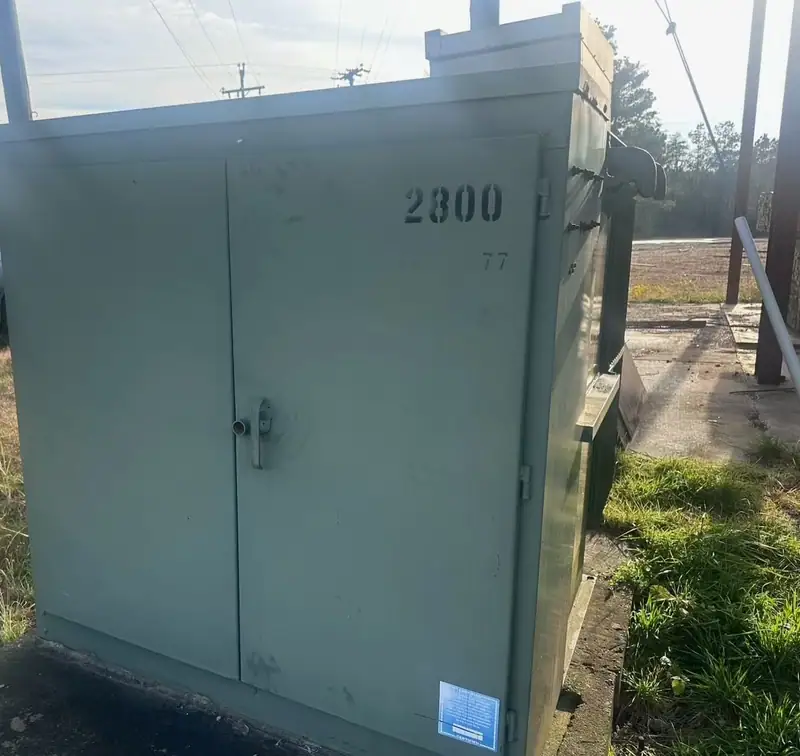
A 75 kVA pole-mount transformer and a 75 kVA three-phase dry-type transformer share a capacity rating, but they are not interchangeable equipment. Phase count, primary and secondary voltages, winding connections and installation type identify what each unit can serve. We buy all brands and sizes within our buying range, including used, new-surplus and decommissioned equipment.
This transformer sizes kVA guide explains how common rating ladders work and what to photograph before selling. Start with the nameplate rather than the cabinet dimensions. For construction-specific information, see the transformer types we buy; this page focuses on capacity ratings and how they relate to the rest of the equipment.
01Single-phase sizes: 10 kVA through 333 kVA
Common single-phase distribution ratings include 10, 15, 25, 37.5, 50, 75, 100, 167, 250 and 333 kVA. Some nameplates show fractional ratings such as 166.7 or 333.3 kVA. These are familiar steps, not a rule that every manufacturer or application follows. We buy single-phase transformers from 10 kVA, including ratings that fall outside this common ladder.
Pole-mount and single-phase pad-mount units appear throughout this range. Three single-phase transformers may also operate together as a three-phase bank. Tell us whether you have one unit, a complete bank or several unrelated units; the rating printed on each transformer is not automatically the total bank rating.
02Three-phase sizes: 15 kVA to 30+ MVA
Common three-phase dry-type ratings include 15, 30, 45, 75, 112.5, 150, 225, 300, 500, 750 and 1,000 kVA. Liquid-filled distribution equipment often includes 75, 150, 225, 300, 500, 750, 1,000, 1,500, 2,000 and 2,500 kVA sizes. Availability varies by product family, so an unfamiliar rating is not a reason to leave a transformer off your inventory.
Above these distribution sizes, ratings increasingly appear in MVA: 5 MVA equals 5,000 kVA, and 30 MVA equals 30,000 kVA. We buy three-phase equipment from 15 kVA through MVA-class power transformers. Send the full specifications for larger units, including 30 MVA and above, rather than treating a size chart as a buying limit.
03Find the rating on the nameplate, not the enclosure
Look for a field marked kVA, KVA, MVA or rated power. Record the phase count beside it, then photograph the entire plate so voltage, frequency, impedance, serial number and cooling information remain readable. A label showing 12470GrdY/7200 and 480Y/277 identifies voltage information, not transformer capacity.
Enclosure dimensions are unreliable substitutes for a rating. Insulation level, cooling design, fluid type and construction can change the physical size of transformers with identical kVA ratings. If a plate is missing or damaged, send any surviving labels and overall photos; original drawings or manufacturer records may help identify the unit. Our seller guides provide additional preparation guidance.
- Photograph every rating line, including alternate voltage or cooling ratings.
- Keep decimal points and units visible: 1.5 MVA and 1,500 kVA are equivalent.
- Include separate plates on attached components, but identify which belongs to the transformer.
04Which transformer forms appear at each size?
Smaller ratings commonly appear in pole-mount, single-phase pad-mount and dry-type equipment. Commercial three-phase sizes appear in dry-type, cast resin and liquid-filled pad-mount transformers. Larger capacities often appear in unit substations, standalone substation transformers and power transformers, although these categories overlap rather than divide at fixed kVA thresholds.
Solar and wind transformers also span multiple capacities. Their rating must be read alongside voltage configuration and application details, not inferred from the project type. We buy oil-filled and dry-type equipment across these forms. Manufacturer names describe the equipment; our brand coverage does not imply manufacturer affiliation.
05Read ONAN and ONAF ratings as separate capacities
Large liquid-filled transformers may carry more than one capacity rating. ONAN means oil natural, air natural cooling; ONAF means oil natural, air forced cooling. An illustrative plate marked 20/26.6 MVA ONAN/ONAF identifies 20 MVA under natural cooling and 26.6 MVA under the specified forced-air cooling conditions. The higher figure is not an unconditional replacement for the lower one.
Some transformers have additional forced-air stages and three listed ratings. Preserve the order of the capacities and their matching cooling designations when recording them. We pay attention to whether fans, radiators and controls are present, and whether the documentation identifies the applicable temperature rise. Photograph the complete rating block rather than sending only the largest MVA number.
06How capacity affects the match for your equipment
Capacity helps define the potential application, but larger does not automatically mean more marketable. A common distribution rating with useful voltages serves a different need from a large, application-specific power transformer. We pay attention to kVA together with primary and secondary voltages, phase, impedance, taps, condition and completeness. Failed or damaged units receive case-by-case review.
For an offer, send a clear nameplate photo, overall photos, location, quantity and condition notes through our offer form. We may ask about PCB documentation, test data or site access; if the equipment fits, our written offer specifies price, freight, loading and payment terms, and pickup is scheduled with you. See how the sale works for details.
We serve sellers throughout Virginia, with neighboring-state and nationwide equipment reviewed on request. PCB status must be disclosed and documented. Do not drain fluid for a sale, and use your own qualified electricians to de-energize and disconnect equipment; we do not perform electrical disconnect work.
Frequently asked questions
Is a transformer's kVA rating the same as kW?
No. kVA measures apparent power, while kW measures real power. For a given load, kW equals kVA multiplied by power factor. When identifying a transformer for sale, report the nameplate kVA or MVA rating rather than converting it to kW using an assumed power factor.
Is the kVA on a three-phase transformer per phase or total?
The nameplate kVA on a complete three-phase transformer normally states its total three-phase capacity. Do not multiply that rating by three. A bank assembled from separate single-phase transformers is different: identify each unit's rating and provide the bank configuration before describing its combined capacity.
Will you buy a transformer with an unusual kVA rating?
Yes, we buy nonstandard ratings within our buying range as well as familiar ladder sizes. An unusual number may reflect a particular application or manufacturer design. Send the actual rating without rounding it to a common size, along with phase, voltages, condition and a complete nameplate photo.
Does a 1,000 kVA transformer have a 1 MVA rating?
Yes, 1,000 kVA equals 1 MVA because one megavolt-ampere equals one thousand kilovolt-amperes. The conversion does not change the equipment's capacity or suitability. Keep any cooling qualifications attached to the rating, especially when a plate lists different capacities for natural cooling and fan-assisted operation.
Should I list the highest rating if the cooling fans are missing?
List every nameplate rating and disclose that the fans are missing. A forced-air rating depends on the specified cooling arrangement and operating conditions; it should not be presented as an available capacity without qualification. Send photos of the radiators, fan mounting locations and remaining controls so the equipment description is complete.
Can you identify transformer size from photos if the nameplate is unreadable?
Overall photos alone generally cannot establish a reliable kVA rating. Send close-ups of all remaining labels, stamped markings and any available drawings or records. Similar-looking tanks and enclosures can contain different capacities. Describe the rating as unknown unless supporting documentation identifies it, rather than estimating from physical dimensions.