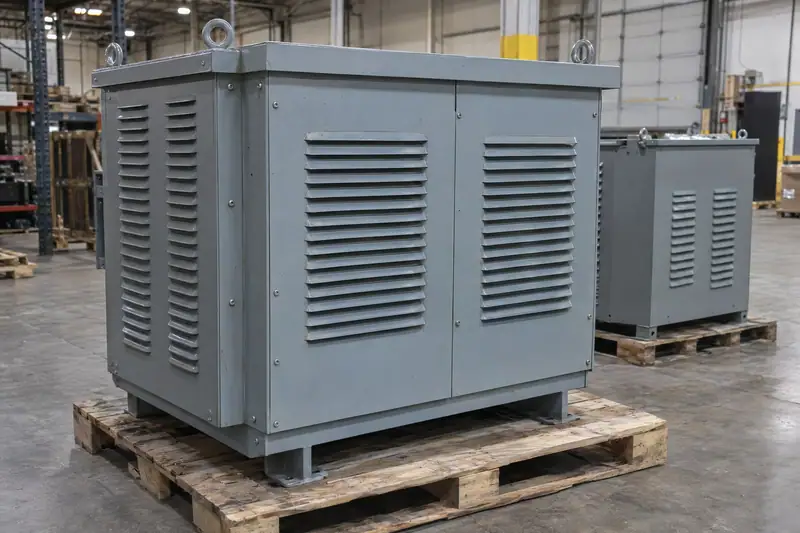
A 30 kVA three-phase transformer often supplies a smaller commercial panel, shop distribution circuit or equipment load. Dry-type construction is common at this rating, particularly where a building needs to change voltage between an existing supply and downstream equipment. We buy these units when they become surplus after renovations, equipment changes or facility closures.
The rating alone does not identify the transformer. A 480-to-208Y/120 unit serves a different purpose from a transformer with a 480Y/277 secondary or a delta secondary. For sellers comparing adjacent ratings, our transformer size guide helps distinguish capacity from voltage, phase and construction.
01What the 30 kVA Rating Means
A 30 kVA rating describes apparent-power capacity under the transformer's specified operating conditions. On a three-phase nameplate, that is the total rating across all three phases, not 30 kVA per phase. It also does not mean the transformer supplies 30 kW to every load; real power depends on the load's power factor.
This size fits applications where the voltage must change but the downstream load does not require a larger distribution transformer. Small commercial panels, compatible rooftop equipment and shop power are typical uses. Motor starting, continuous loads and future additions still require proper sizing by the seller's qualified electrical professional.
For sellers, the useful distinction is between capacity and application. Two 30 kVA transformers can have different connections, temperature-rise ratings and enclosure configurations. We pay attention to those details because a replacement buyer needs equipment that matches more than the number on the front.
02Voltage Combinations and Full-Load Current
A common combination at this size is a 480 V primary with a 208Y/120 V secondary. The wye secondary provides 208 V between phases and 120 V from phase to neutral when installed appropriately. Other configurations include 208 V primary to 480Y/277 V secondary and 480 V primary to 240 V delta secondary. Read the actual plate rather than identifying voltage from the enclosure.
Connection details matter. A 240 V delta secondary is not interchangeable with a 208Y/120 V secondary, and a neutral terminal does not make every winding arrangement equivalent. Send the wiring diagram if it is separate from the main plate, including tap positions and any terminal markings.
Use the amp table on this page to compare rated current at different voltages. For one worked example, three-phase full-load current equals kVA × 1,000 ÷ (√3 × line-to-line volts): at 480 V, 30 × 1,000 ÷ (1.732 × 480) is approximately 36.1 A. Our kVA and full-load amps guide explains the relationship; this calculation is not a breaker-sizing instruction.
Full-load amps for a 30 kVA three-phase transformer
The amp table on this page uses the standard formula Amps = kVA × 1,000 ÷ (1.732 × line-to-line volts). Match the voltage on your nameplate to read the rated full-load current of each winding.
| Winding voltage | Full-load amps |
|---|---|
| 208 V | 83.3 |
| 240 V | 72.2 |
| 480 V | 36.1 |
| 600 V | 28.9 |
| 2,400 V | 7.2 |
| 4,160 V | 4.2 |
| 12,470 V | 1.4 |
| 13,200 V | 1.3 |
| 13,800 V | 1.3 |
| 23,000 V | 0.8 |
| 34,500 V | 0.5 |
03Confirm 30 kVA on the Nameplate
Look for a field labeled kVA, rated kVA or capacity, then confirm that the phase field says three-phase or 3 PH. Do not use a panel schedule, breaker label or handwritten inventory tag as the only evidence. A cabinet can resemble a nearby size even when its electrical rating is different.
Photograph the entire plate straight on so the model, serial number and electrical fields remain readable. Include the connection diagram and tap information when available. On ventilated dry-type transformers, temperature rise, insulation class, frequency and enclosure type help identify the unit more precisely.
If the plate says 15 kVA or 45 kVA, describe it at that rating rather than rounding to 30 kVA. We also buy 15 kVA transformers and 45 kVA transformers. If a plate is missing, send any remaining manufacturer labels and explain what documentation you have.
- Rated capacity and number of phases
- Primary voltage, secondary voltage and winding connections
- Manufacturer, model and serial number
- Frequency, taps, temperature rise and insulation class
- Enclosure type and listed weight, if shown
04Physical Size, Weight and Removal Access
There is no single cabinet size or weight for a 30 kVA transformer. Copper or aluminum windings, enclosure design, temperature-rise rating and construction all affect the package. A compact appearance does not mean a unit can be handled safely by hand. Use a manufacturer-listed weight when available instead of estimating from a photograph.
Overall photos should show the front, sides, base and mounting arrangement. Note whether the transformer sits on the floor, hangs from a wall bracket or occupies an elevated platform. Include approximate cabinet dimensions and explain any narrow doors, stairs or restricted loading access.
We do not perform electrical disconnect work. Sellers use their own qualified electricians to de-energize and disconnect equipment before pickup. Keep covers and identification labels with the transformer, and disclose loose parts or mounting damage rather than attempting repairs just to prepare it for sale.
05What Makes a 30 kVA Unit Useful to Another Buyer
Demand for a particular 30 kVA unit depends on its voltage combination, condition and application fit. A standard commercial distribution configuration can suit more replacement needs than an unusual voltage or specialized enclosure. That does not establish a fixed resale value or guarantee an offer.
We buy all brands, including units identified on our Square D transformer page. Brand names describe equipment; Virginia Transformer Buyers is an independent buyer and is not affiliated with any manufacturer, including Virginia Transformer Corp of Roanoke.
Condition notes should distinguish normal service wear from electrical damage. Tell us about water exposure, overheating, burned insulation, missing covers or known winding faults. Used and new-surplus units are welcome; failed or damaged transformers are reviewed case by case. Available test records help describe condition, but do not energize a disconnected unit solely to demonstrate operation.
06Information We Need for a 30 kVA Offer
To sell 30 kVA transformer equipment, send a clear nameplate photo, overall photos, location, quantity and condition notes. We review the information and may ask about test data, site access or PCB status, which must be disclosed and documented. If the equipment fits, we send a written offer covering price, freight, loading and payment terms; pickup is scheduled with you, and payment follows those terms. See how the buying process works for details.
For a group of transformers, identify each unit separately. Similar-looking cabinets may have different voltages or ratings, so pair each nameplate photo with its corresponding overall photo. Tell us whether each unit is still connected, already disconnected or stored as unused surplus.
Send your 30 kVA equipment details through the offer request form. A readable plate and a clear description of the unit's location give us a better starting point than a capacity number alone.
Frequently asked questions
Can I sell a 30 kVA transformer that is still connected?
Yes, you can submit a connected 30 kVA transformer for review. State that it is still installed and photograph accessible labels without opening energized equipment. Virginia Transformer Buyers does not perform disconnect work. Your qualified electrician must de-energize and disconnect the unit before pickup, with access and loading addressed in the written terms.
Do you buy 30 kVA transformers with aluminum windings?
Yes, we buy 30 kVA transformers with aluminum windings as well as copper windings. Winding material is one identification detail, not the sole basis for an offer. Send the nameplate, voltage configuration and condition notes. If the winding material is not documented, report it as unknown rather than guessing from the cabinet.
Is a 30 kVA transformer the same as three 10 kVA transformers?
No, a single 30 kVA three-phase transformer is not the same equipment package as three separate 10 kVA single-phase transformers. A properly configured bank may provide equivalent total apparent-power capacity, but connections, installation and protection differ. Describe what you actually have and send each unit's nameplate if you are selling a bank.
Can I sell a 30 kVA transformer removed from rooftop equipment?
Yes, we buy 30 kVA transformers removed from rooftop equipment applications. Send the transformer's own nameplate rather than only the HVAC equipment label. Include its enclosure condition, voltage connections and any weather exposure. If it remains on the roof, describe the location and removal access so those requirements can be addressed.
Will you buy a 30 kVA dry-type transformer with a burned winding?
A 30 kVA dry-type transformer with a burned winding is reviewed case by case. Disclose the known failure and include photos of visible damage, the nameplate and the complete enclosure. Tell us whether covers, terminals or other parts are missing. Do not describe a failed unit as operational or energize it for a demonstration.