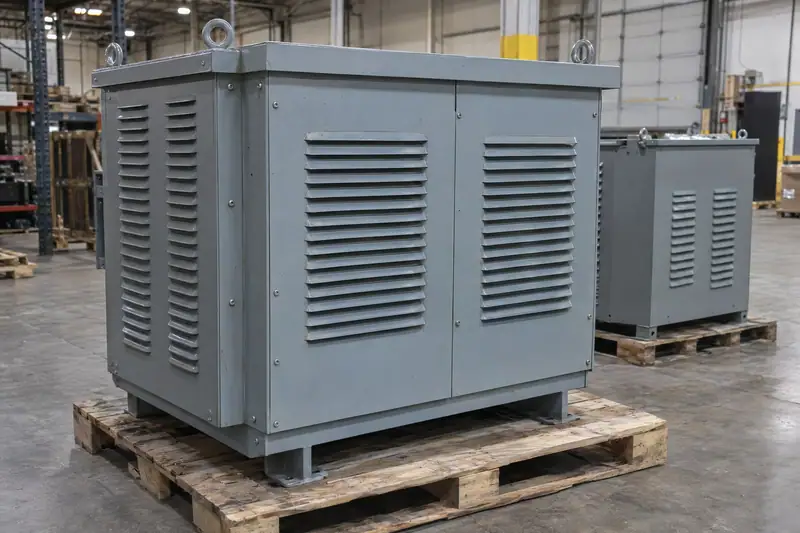
A 15 kVA three-phase transformer often serves a small panel rather than an entire building. Common applications include lighting, receptacles and control-power loads where the available supply voltage differs from the voltage the equipment needs. Dry-type construction is common at this rating, making enclosure and terminal-compartment photos particularly useful.
We buy 15 kVA three-phase transformers across Virginia, whether one unit is left after a renovation or several are surplus to a project. Our transformer size guide covers other ratings, but this page focuses on the details that matter for a small three-phase unit: nameplate rating, winding voltages, completeness and handling.
01What the 15 kVA Rating Actually Means
The 15 kVA nameplate rating describes the transformer's apparent-power capacity under its specified operating conditions. On a three-phase transformer, it is the total rating across all three phases, not 15 kVA per phase. It does not mean the transformer continuously draws that much power.
The rating is also not automatically 15 kW of usable load. Real power depends on load power factor, while suitability for a particular application also involves voltage, load characteristics and installation requirements. A small lighting panel and a machine-control installation can use the same transformer rating without having identical operating demands.
Confirm that the plate identifies three-phase service, often shown as “3 PH” or “3-phase.” We buy three-phase equipment starting at 15 kVA and single-phase equipment starting at 10 kVA, but the two are not interchangeable. Tell us the phase count rather than identifying a unit by enclosure size alone.
02Voltage Combinations and Full-Load Current
A common 15 kVA dry-type configuration steps 480 V three-phase down to 208Y/120 V. The secondary provides 208 V between phases and 120 V from a phase to the neutral. Another configuration is 208 V primary to 480Y/277 V secondary, providing 480 V between phases and 277 V phase to neutral.
Other winding arrangements exist, including units with reconnectable primary windings. Copy the primary and secondary information exactly as printed, including delta or wye markings and any connection diagram. Taps allow specified voltage adjustment; they do not make every transformer suitable for arbitrary input voltages.
Use the amp table on this page to compare full-load current at different voltages. For one example, three-phase current at 480 V is I = 15,000 VA ÷ (√3 × 480 V), or approximately 18.0 A. This is rated current, not a breaker-sizing instruction; our kVA and full-load amps guide explains the relationship.
Full-load amps for a 15 kVA three-phase transformer
The amp table on this page uses the standard formula Amps = kVA × 1,000 ÷ (1.732 × line-to-line volts). Match the voltage on your nameplate to read the rated full-load current of each winding.
| Winding voltage | Full-load amps |
|---|---|
| 208 V | 41.6 |
| 240 V | 36.1 |
| 480 V | 18 |
| 600 V | 14.4 |
| 2,400 V | 3.6 |
| 4,160 V | 2.1 |
| 12,470 V | 0.7 |
| 13,200 V | 0.7 |
| 13,800 V | 0.6 |
| 23,000 V | 0.4 |
| 34,500 V | 0.3 |
03Nameplate Details That Identify Your Transformer
A readable nameplate is more useful than a description such as “small shop transformer.” Look for 15 kVA, three-phase identification, frequency, primary voltage and secondary voltage. Include the catalog or model number and serial number so we can distinguish otherwise similar units.
Dry-type plates may also list temperature rise, insulation-system rating, enclosure type and a winding connection diagram. These details describe construction and operating limits; they should not be guessed from paint color or cabinet shape. A photo that cuts off the connection diagram leaves important information missing.
Send a straight-on image with enough light to read the smaller print, plus a wider photo showing where the plate belongs on the unit. We buy all brands, including Siemens transformers. Manufacturer names identify the equipment only; Virginia Transformer Buyers is an independent buyer, not affiliated with any manufacturer.
- Photograph the full nameplate, including voltage and connection information.
- Include any separate wiring-diagram or enclosure label.
- Identify each unit separately when selling several similar transformers.
04Dry-Type Construction, Dimensions and Handling
At 15 kVA, a dry-type transformer may look compact, but the core, windings and enclosure still create a substantial handling load. Dimensions and weight vary with winding material, enclosure design and construction. Do not use another manufacturer's 15 kVA unit as a reliable weight reference.
For our dry-type transformer purchases, useful photos show the enclosure, ventilation openings, mounting points and any visible impact damage. Note missing covers, damaged terminal hardware, corrosion or signs of overheating. Interior photos should only be taken when equipment is safely de-energized and access is appropriate.
Send listed weight if available, along with approximate height, width and depth. Also explain whether the transformer is floor-mounted, wall-mounted, on a pallet or still connected. Stairs, narrow doors and elevated mounting locations matter to pickup planning. We do not perform electrical disconnect work; use your own qualified electrician to de-energize and disconnect it.
05What Makes a 15 kVA Unit Useful to Another Buyer
Demand for this size is tied to specific smaller loads. A matching voltage combination can make a 15 kVA transformer useful for a small distribution panel, lighting circuits or control-power equipment. Its usefulness depends on the receiving application, not simply on having copper or aluminum windings.
We pay attention to legible identification, complete enclosures, intact connections and a clear condition history. New-surplus equipment should be described with storage conditions and any missing packaging or components. For used units, tell us whether the transformer was operating when removed or whether its condition is unknown.
A larger rating is not always a better match for a small load. Our 30 kVA transformer page covers the next larger size, but correct identification matters more than grouping everything as small transformers. Failed or damaged 15 kVA units are reviewed case by case; disclose the failure rather than presenting them as working equipment.
06What We Need for a 15 kVA Transformer Offer
To sell 15 kVA transformer equipment, send a clear nameplate photo, overall photos, location, quantity and condition notes. We review the information and may ask about test data, PCB status or site access. If the equipment fits, we send a written offer specifying price, freight, loading and payment terms, then schedule pickup with you; payment follows those terms. See how the purchase works for details.
For a small dry-type unit, be specific about loose parts and removal status. Tell us whether covers, mounting hardware and terminal components are present, and whether the equipment is already disconnected. Existing test reports can help document condition, but do not describe a unit as tested unless you have supporting information.
Send your photos through the transformer offer form. If the unit is liquid-filled rather than dry-type, identify the fluid and provide available records. PCB status must be disclosed and documented, and we do not ask sellers to drain fluid.
Frequently asked questions
Will you buy just one used 15 kVA three-phase transformer?
Yes, we buy individual used 15 kVA three-phase transformers as well as multiple-unit quantities. Send the nameplate and overall photos, location and condition notes for your unit. Identify its primary and secondary voltages and whether it was operating before removal. Purchase terms depend on the equipment and are stated in the written offer.
Is a 15 kVA three-phase transformer rated 15 kVA per phase?
No, a three-phase transformer marked 15 kVA has a total three-phase rating of 15 kVA. Do not multiply that rating by three when describing it for sale. Photograph the phase designation and kVA field together, particularly if several transformers are stored nearby or the enclosure has labels from a previous installation.
Can I sell a 15 kVA transformer with a missing enclosure cover?
Disclose the missing cover and send photos; damaged or incomplete units are reviewed case by case. A missing cover affects completeness and leaves components exposed, so do not describe the transformer as ready to install. Include any detached covers or hardware you still have and note other missing parts.
Does a 208Y/120 V nameplate mean the transformer is single-phase?
No, 208Y/120 V commonly identifies a three-phase wye secondary, with 208 V phase to phase and 120 V phase to neutral. Confirm the phase designation elsewhere on the nameplate rather than relying on voltage alone. Send the primary voltage and connection diagram too, since the secondary marking does not identify the entire transformer.
Can I sell an older 15 kVA transformer without test reports?
You can submit an older 15 kVA transformer without test reports, but clearly state that reports are unavailable. Describe its operating history, storage conditions and any known faults without guessing. We may ask follow-up questions about condition. If it is liquid-filled, PCB status must also be disclosed and documented; age alone does not establish that status.