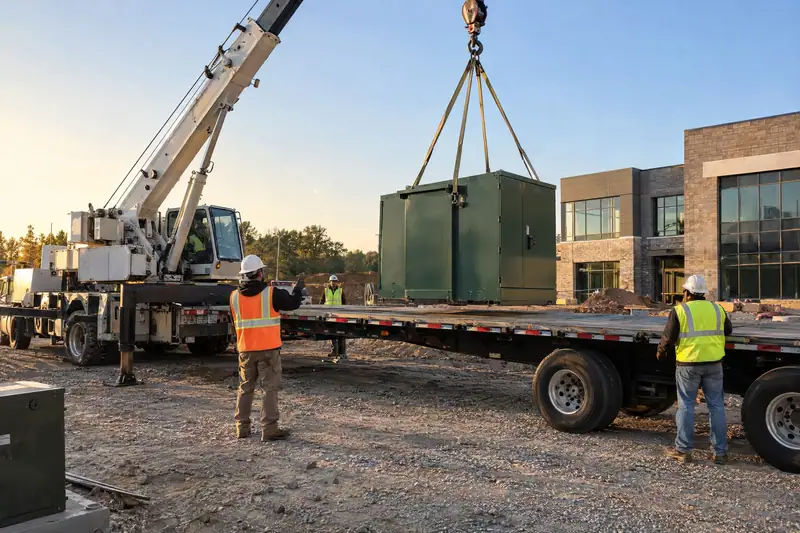
A 1,500 kVA three-phase transformer often sits between a medium-voltage supply and a substantial low-voltage load. You may find one serving industrial equipment, a data center distribution system or a utility-scale solar block. The same capacity can come in very different packages, so the enclosure and connections matter alongside the rating.
We buy 1,500 kVA transformers across Virginia, whether they are unused surplus, operating equipment scheduled for replacement or decommissioned units. If you want to sell 1,500 kVA transformer equipment, start with the actual nameplate rather than a project schedule or inventory description. Our transformer size directory covers other ratings when a site has several units available.
01What a 1,500 kVA rating tells us
A 1,500 kVA rating means 1,500 kilovolt-amperes of apparent power under the transformer's specified operating conditions. On a three-phase nameplate, that is normally the total three-phase rating, not 1,500 kVA per phase. It does not automatically mean 1,500 kW of usable load; real power depends on power factor, and installation conditions affect loading.
Cooling ratings deserve a close look. A liquid-filled transformer may show separate ONAN and ONAF ratings for natural cooling and fan-assisted cooling. If 1,500 kVA is a fan-cooled rating rather than the base rating, tell us and photograph the cooling equipment. On dry-type units, capture any separate self-cooled and forced-air ratings too.
02Pad-mount, unit substation and substation configurations
At this capacity, three-phase pad-mount equipment combines the transformer with enclosed cable compartments. We pay attention to dead-front or live-front construction, loop-feed or radial-feed arrangements, primary connection details and secondary termination space. Photos of accessible compartments help distinguish otherwise similar pad-mount transformers, but do not open energized equipment to take them.
A 1,500 kVA transformer may also be the center section of a unit substation, connected to primary switching equipment and secondary distribution gear. Tell us whether those adjoining sections are included or whether only the transformer is available. For unit substation equipment, flange locations, bus connections and the original assembly drawings can be especially useful.
Separate substation units may use exposed bushings, cable boxes or other connection arrangements rather than pad-mount compartments. We buy liquid-filled and dry-type equipment, including cast resin units. With substation transformers, show the bushings, radiators and connection enclosures so the equipment's configuration is clear before loading is planned.
Full-load amps for a 1,500 kVA three-phase transformer
The amp table on this page uses the standard formula Amps = kVA × 1,000 ÷ (1.732 × line-to-line volts). Match the voltage on your nameplate to read the rated full-load current of each winding.
| Winding voltage | Full-load amps |
|---|---|
| 208 V | 4,164 |
| 240 V | 3,608 |
| 480 V | 1,804 |
| 600 V | 1,443 |
| 2,400 V | 361 |
| 4,160 V | 208 |
| 12,470 V | 69.4 |
| 13,200 V | 65.6 |
| 13,800 V | 62.8 |
| 23,000 V | 37.7 |
| 34,500 V | 25.1 |
03Voltage combinations and full-load current
You may see 1,500 kVA equipment with a 12,470-volt or 13,800-volt primary and a 480Y/277-volt secondary. Other units use a 4,160-volt primary or a medium-voltage secondary. A marking such as 12470GrdY/7200 identifies a grounded-wye voltage relationship; it should not be reduced to a single number when describing the winding. Copy the complete voltage markings, including delta or wye information.
Industrial service and data center distribution can use 480Y/277-volt secondaries, while solar installations may require different inverter-side voltages and winding arrangements. Capacity alone does not establish interchangeability. Primary taps, impedance, grounding configuration and basic impulse insulation level, or BIL, help determine whether a transformer matches another installation.
Use the amp table on this page to compare full-load current at different three-phase voltages. For one example, current at 480 volts is I = (1,500 × 1,000) ÷ (√3 × 480), approximately 1,804 amps. This is calculated rated current, not a recommendation for conductor sizing or protective settings. The kVA and full-load amps guide explains the relationship further.
04Confirm the rating and capture the useful nameplate details
Find the manufacturer's nameplate and photograph it straight on, close enough to read the small print. Look for 1,500 kVA, 1500 kVA or 1.5 MVA, then check whether the plate lists multiple cooling capacities. A nearby switchgear label or site asset tag is not a substitute for the transformer's own rating plate.
We pay attention to the complete electrical and construction information, not just the capacity. Include any second plate covering fluid, accessories or connection diagrams. If the plate references an IEEE C57 standard, capture that text rather than trying to interpret it. For liquid-filled equipment, PCB status must be disclosed and documented; do not infer it solely from age.
- Manufacturer, model, serial number and manufacture date if shown
- Three-phase kVA ratings, frequency and cooling class
- Primary and secondary voltages, winding connections and tap positions
- Percent impedance and BIL ratings
- Fluid type, fluid quantity and total weight if listed
- Available test reports and documented PCB status
05Physical dimensions, weight and site access
There is no single shipping size or weight for every 1,500 kVA transformer. Liquid volume, enclosure design, radiators, winding material and attached equipment all affect the package. Use the nameplate weight and manufacturer drawings when available, and distinguish total assembled weight from any separately listed core-and-coil or fluid weight.
Measure overall height, width and depth, including protruding radiators, bushings and cable boxes. Tell us whether the unit is outdoors on a pad, inside an electrical room or attached to other substation sections. Door openings, overhead clearance, access roads and the distance to a loading area can affect freight and loading arrangements. Do not drain fluid for a sale; sellers use their own qualified electricians to de-energize and disconnect equipment.
06What makes a 1,500 kVA transformer a useful buying fit
A 1,500 kVA rating is relevant to substantial three-phase distribution loads, but demand depends on the complete specification. A common service voltage, readable documentation and usable connection hardware can make matching equipment easier. Unusual secondary voltages, missing parts or application-specific solar configurations narrow the possible fit. We buy all brands; the nameplate brand describes the equipment, not an affiliation.
To sell 1,500 kVA transformer equipment, send a clear nameplate photo, overall photos, location, quantity and condition notes through our offer form. We review the details and may ask about PCB documentation, test data or access. If the equipment fits, we send a written offer specifying price, freight, loading and payment terms; pickup is scheduled with you, and payment follows those terms. See how the selling process works for details.
Frequently asked questions
Is a 1.5 MVA transformer the same size as a 1,500 kVA transformer?
Yes, 1.5 MVA equals 1,500 kVA. The units express the same apparent-power capacity, but check which cooling condition applies to that rating. Two transformers marked 1.5 MVA can still have different voltages, winding connections, impedance and physical construction, so send the complete nameplate rather than only the capacity.
Will you buy a 1,500 kVA transformer with a 480Y/277 secondary?
Yes, Virginia Transformer Buyers buys 1,500 kVA three-phase transformers with 480Y/277-volt secondaries. Include the primary voltage, tap information, impedance and connection configuration. The secondary rating alone does not identify the complete unit, and photos of the primary and secondary connection areas help show which hardware is included.
Can I sell a 1,500 kVA solar transformer with an unusual secondary voltage?
Yes, we buy solar transformers, including 1,500 kVA units, but the exact voltage and winding configuration matter to the buying fit. Send every winding rating and the connection diagram if available. Include whether the unit is unused surplus or previously operated, along with any available test reports and fluid documentation.
Do attached fans change how I should describe my 1,500 kVA transformer?
Yes, attached fans may correspond to a separate forced-cooling capacity, so describe all ratings printed on the nameplate. Do not assume that 1,500 kVA is the natural-cooling rating. Photograph the fans and controls, and note any missing or known nonworking components so the equipment's condition is accurately represented.
Can I sell only the transformer section of a 1,500 kVA unit substation?
Yes, we buy transformer sections as well as unit substation equipment. Clearly identify which sections and connection components are included in the sale. Photos of both ends, bus interfaces and flange openings help distinguish the transformer from the complete assembly. Sellers are responsible for qualified electrical de-energizing and disconnect work.
Will you buy a failed 1,500 kVA oil-filled transformer?
Failed 1,500 kVA oil-filled transformers are reviewed case by case. Describe the known failure, leaks, visible damage and missing components, and include available test information. PCB status must be disclosed and documented. Do not drain the fluid for sale; photographs and condition records help us understand what equipment is available.