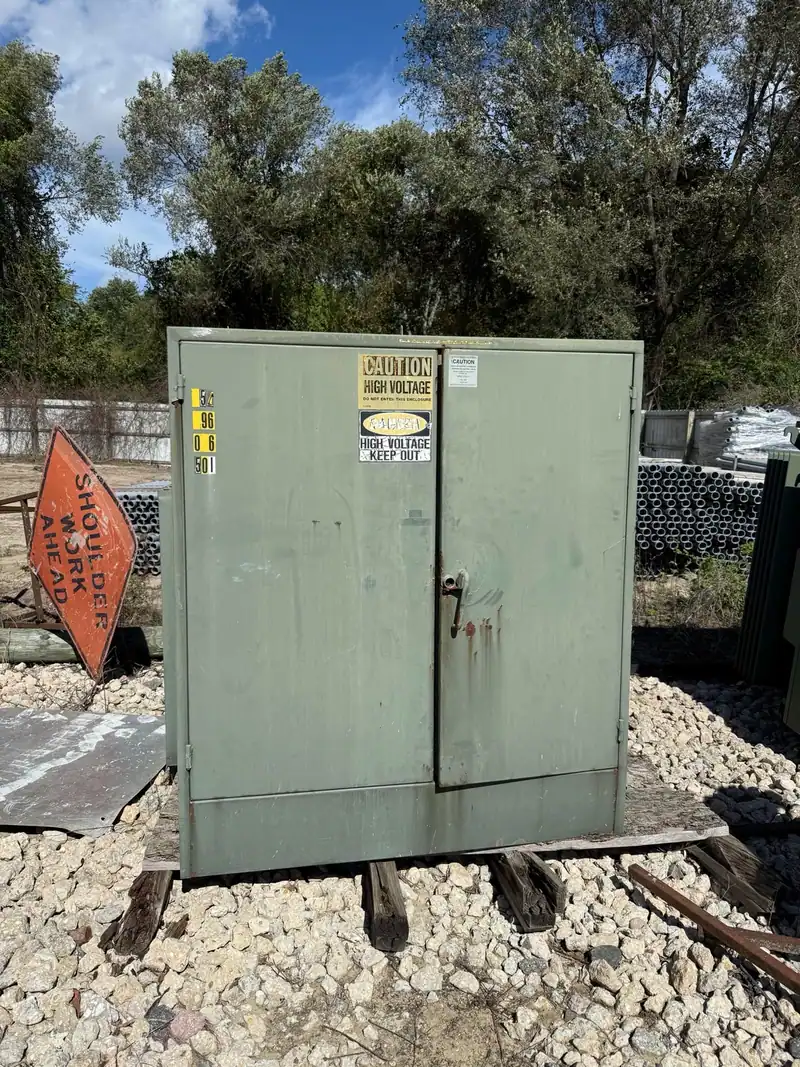
We buy the low-profile single-phase transformers installed along subdivision streets, beside residential service points and throughout underground residential distribution systems. Builders, electrical contractors, utilities and co-ops can have these units left over when construction phases change or inventory no longer matches planned loads. An unused cabinet on a storage pad can still have a useful electrical configuration.
Single-phase URD equipment deserves a closer look than a general description of “pad-mount transformer.” A 50 kVA loop-feed unit with a 12470GrdY/7200 primary and 120/240 secondary is different from another unit with the same cabinet dimensions. This page covers those distinctions; our broader pad-mount transformer buying page covers other pad-mounted configurations.
01Single-phase URD sizes and secondary ratings
We buy single-phase pad-mount transformers from 10 kVA across all brands. Ratings sellers encounter in residential distribution include 25, 37.5, 50, 75, 100 and 167 kVA. The kVA rating describes transformer capacity, not the number of homes it can serve. Actual loading depends on the service design and demand, so send the nameplate rather than estimating capacity from the installation.
A 120/240 V secondary is common for single-phase residential service. Other secondary ratings need to be identified exactly, including any reconnectable arrangements shown on the plate. We buy both smaller units and larger single-phase ratings; the 50 kVA single-phase page and 167 kVA equipment page provide size-specific context. A readable rating plate is more useful than cabinet height or shipping weight alone.
- Photograph the kVA rating, serial number and manufacturing date.
- Include the complete primary and secondary voltage markings.
- Show tap positions or connection diagrams if they appear on separate plates.
- Record fluid type, fluid quantity and total weight where listed.
02Primary voltage and loop-feed details matter
Primary voltage needs to match the equipment description, not just the local utility's shorthand. On a plate marked 12470GrdY/7200, 12,470 V identifies the grounded-wye system's line-to-line voltage and 7,200 V its line-to-neutral voltage. Other URD units may carry markings such as 24940GrdY/14400 or 34500GrdY/19920. Photograph the full notation, including any dual-voltage connections and tap information.
Loop-feed single-phase cabinets commonly have two primary bushing wells, allowing cable connections into and out of the transformer position. Radial-feed units commonly have one primary connection. Two wells do not establish every detail of the protection scheme or internal switching. We pay attention to the bushing arrangement, loadbreak interfaces, fuse provisions and any switch labels, so include a clear compartment photo when it can be taken safely by qualified personnel.
- Identify loop-feed or radial-feed configuration from the plate and equipment documentation.
- Show whether bushing inserts, protective caps and other accessories are present.
- Photograph fuse and switch labels without operating the equipment.
- Note missing parts or changes from the original factory configuration.
03Cancelled subdivision phases and surplus inventory
A cancelled subdivision phase can leave a builder with transformers ordered for homes that will not be built on the original schedule. A revised service layout can also leave the wrong kVA sizes or primary-voltage configurations in storage. We buy new-surplus single-phase pad-mounts, including equipment that never entered service. Describe it as unused only when its history supports that description.
Co-ops and utilities can have overstock after purchasing plans change, standardized specifications shift or stock is consolidated. Contractors may have project leftovers with different ratings rather than one uniform lot. As a single-phase pad-mounts buyer, we want the actual inventory, not an assumed replacement specification. Purchase records, factory paperwork and storage history help distinguish never-energized surplus from equipment removed after service.
04Selling quantity lots without losing unit-level details
We buy individual transformers and quantity lots. For a row of similar green cabinets, assign each unit a simple inventory number and match it to a nameplate photo. Group units by kVA, primary voltage, secondary voltage and feed configuration, but keep serial numbers separate. A lot described as “twenty residential transformers” can contain several configurations with different reuse potential.
Mixed-brand lots are welcome. We buy all brands, including Howard Industries transformers and ERMCO equipment; the brand identifies the equipment, not an affiliation. Note which units are unused, previously energized, missing accessories or damaged. For a larger inventory, a spreadsheet paired with labeled photos makes those differences easier to review without confusing one cabinet with another.
- Use one row per unit with its inventory number and serial number.
- Separate confirmed nameplate details from information that is unknown.
- Identify units stored at different locations.
- Include approximate dimensions and listed weights when available.
- Photograph representative storage conditions as well as each nameplate.
05Cabinet condition, fluid type and PCB documentation
Modern single-phase pad-mounts commonly use insulating fluids specified as non-PCB, but age or appearance alone does not document PCB status. PCB status must be disclosed and documented. Send applicable manufacturer labels, records or fluid test reports rather than calling a unit PCB-free because it looks recent. Also identify whether the fluid is mineral oil, FR3 natural ester or another fluid listed by the manufacturer.
Low-profile cabinets can develop corrosion around the base, door edges and areas exposed to standing water. We pay attention to leaks, damaged bushings, missing doors, compromised locking provisions and evidence of flooding or impact. Describe those conditions plainly and include photos. Failed or damaged units are reviewed case by case. Do not drain fluid for a sale; we do not ask sellers to do that.
06Prepare your URD transformers for a buying review
We buy used and decommissioned equipment as well as new-surplus stock, so include the service history you actually know. A removal date, reason for retirement and available test records are useful details. If a unit remains installed, say whether it is energized and describe access around the pad. Sellers use their own qualified electricians to de-energize and disconnect; we do not perform electrical disconnect work.
Send clear nameplate and overall photos, location, quantity and condition notes through the equipment offer form. We review the equipment and may ask about PCB documentation, test data or site access. If it fits, we send a written offer specifying price, freight, loading and payment terms; pickup is scheduled with you, and payment follows those terms. See how the buying process works for details.
Frequently asked questions
Can I sell single-phase pad-mounts from a cancelled subdivision?
Yes, we buy surplus single-phase pad-mount transformers from cancelled or revised subdivision projects. Identify which units were never energized and which were installed or used. Include original specifications if available, especially primary voltage, secondary voltage and loop-feed configuration. Storage condition and missing accessories matter even when the transformers never entered service.
Do you buy 7,200-volt loop-feed residential transformers?
Yes, we buy single-phase loop-feed residential transformers with a 7,200 V primary winding rating. Send the complete nameplate notation, such as 12470GrdY/7200, rather than only “7,200 volts.” Include kVA, secondary voltage and primary-compartment details. Those fields distinguish equipment that may look identical from outside but has different electrical specifications.
Can I sell a mixed lot of 25, 50 and 100 kVA pad-mounts?
Yes, we buy mixed lots containing different single-phase kVA ratings. List each unit separately with its serial number, voltages, feed configuration and condition. Matching inventory labels to photos prevents confusion when cabinets look alike. You do not need to describe the entire lot as one size or one condition.
Are newer single-phase pad-mount transformers automatically PCB-free?
No, a newer appearance or manufacturing date alone is not sufficient documentation of PCB status. Modern units commonly have non-PCB fluid specifications, but PCB status must still be disclosed and documented. Send manufacturer labeling, applicable records or test reports. If status is unknown, state that clearly rather than assuming it.
Will missing elbows or bushing inserts prevent a sale?
Missing elbows or bushing inserts do not automatically prevent a sale, but they must be identified. Show the primary compartment safely and note missing accessories, exposed connections or damaged components. Do not remove parts to improve the description. Failed or damaged transformers are reviewed case by case, with the condition stated accurately.
Can I sell a pad-mount transformer that is still connected?
You can submit a still-connected single-phase pad-mount for review, but disclose that it remains installed and whether it is energized. Sellers arrange de-energization and disconnection through their own qualified electricians. We do not perform that work. Photographs should not require you to open energized compartments or approach exposed electrical parts.