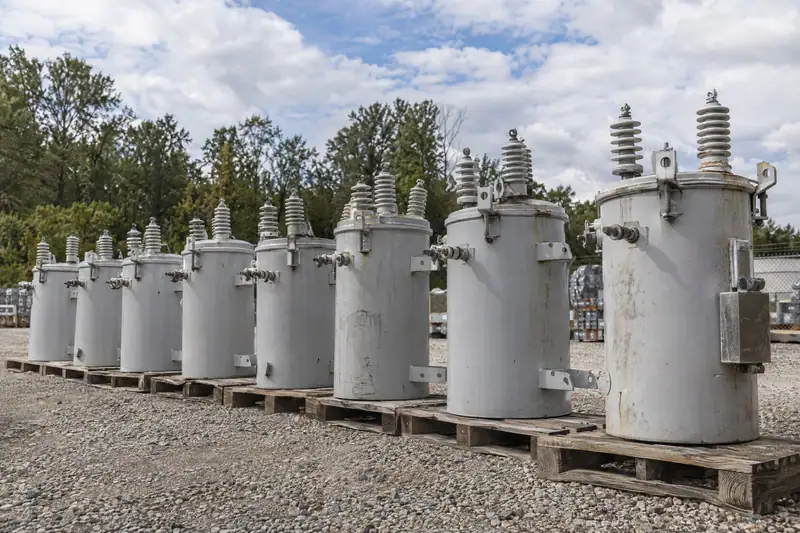
A 50 kVA single-phase transformer can serve residential distribution, a small commercial service or agricultural loads. At this rating, the two common forms are a cylindrical pole-mounted unit and a ground-level pad-mounted cabinet. The same kVA marking does not make them interchangeable: primary voltage, secondary connections, enclosure and protection arrangements still have to match the application.
We buy this size as individual units and in surplus lots. If you want to sell 50 kVA single-phase transformer equipment left from a subdivision project, service change or farm upgrade, start with the actual nameplate rather than a project description. Our transformer size guide helps distinguish this rating from other equipment in the same inventory.
01What the 50 kVA Single-Phase Rating Means
The 50 kVA rating describes apparent power capacity under the transformer's specified operating conditions. It is not a statement that every connected load can use 50 kW. Real power depends on load power factor, while allowable loading also depends on installation conditions and the manufacturer's ratings.
For single-phase full-load current, use amps = kVA × 1,000 ÷ volts. One example: a 50 kVA transformer rated at 240 volts has a calculated full-load secondary current of 50,000 ÷ 240, or about 208.3 amps. Use the amp table on this page for other listed voltages, and see the kVA and full-load amps guide for the calculation background.
A 120/240-volt center-tapped secondary needs particular attention. Its two halves supply line-to-neutral loads, while the full winding supplies line-to-line loads. The total kVA marking does not mean the entire capacity is available from either half alone. Uneven loading and winding limits matter when matching the unit to a service.
02Pole-Mount and Pad-Mount Units at This Size
We buy 50 kVA single-phase pole-mount transformers, including surplus inventory and units removed from service. Photos should show the tank, mounting brackets, primary bushings, secondary terminals and any visible protection hardware. Some units use external protective devices; others have integral protection. Those differences should be identified rather than guessed from the tank shape.
We also buy 50 kVA single-phase pad-mounted transformers. These commonly serve underground residential distribution and other ground-level installations. Cabinet condition, doors, hinges, terminal compartment condition and the arrangement of primary connections help describe what is being sold. Dead-front connector interfaces and loop-feed or radial-feed arrangements are useful details when present.
Residential subdivisions may generate unused project stock or equipment released during service changes. Small commercial properties, farms and well installations can also have this rating. The previous application gives context, but it does not establish the transformer's voltage or present condition. Include whether the unit was operating when removed and whether anything was damaged during removal or storage.
Full-load amps for a 50 kVA single-phase transformer
The amp table on this page uses the standard formula Amps = kVA × 1,000 ÷ volts. Match the voltage on your nameplate to read the rated full-load current of each winding.
| Winding voltage | Full-load amps |
|---|---|
| 120 V | 417 |
| 240 V | 208 |
| 480 V | 104 |
| 2,400 V | 20.8 |
| 7,200 V | 6.9 |
| 7,620 V | 6.6 |
| 7,970 V | 6.3 |
| 14,400 V | 3.5 |
| 19,920 V | 2.5 |
03Typical Voltages and Nameplate Details
A common secondary at this size is 120/240 volts, particularly for residential and farm services. Medium-voltage primaries vary with the distribution system. A nameplate marked 12470GrdY/7200 typically identifies a 7,200-volt line-to-neutral application on a grounded-wye system with 12,470 volts line-to-line. Other primary ratings exist, so send the marking exactly as printed.
Confirm that the plate says 50 kVA and single-phase, or shows a phase designation of 1. Do not substitute the service panel rating, a handwritten inventory tag or the rating of nearby equipment. A legible photograph should capture the whole plate, including the connection diagram and any separate voltage or tap markings.
We pay attention to the serial number, manufacturer, primary and secondary voltages, frequency, impedance, tap range, temperature-rise information and fluid identification where listed. Connection diagrams can clarify terminal relationships that voltage numbers alone do not explain. If a plate is worn, send close-up photos from several angles rather than filling in unreadable fields from memory.
- Photograph the 50 kVA rating and single-phase designation.
- Include every listed primary and secondary voltage.
- Capture the connection diagram, tap information and serial number.
- Show fluid labels and any PCB documentation separately.
04Physical Size, Weight and Storage Condition
There is no single shipping weight or footprint for every 50 kVA transformer. Tank design, cabinet construction, conductor material, fluid volume and accessories all affect handling. A pole-mounted tank and a pad-mounted cabinet with the same electrical rating can have substantially different dimensions and lifting arrangements.
Send the nameplate weight if shown, along with approximate overall dimensions and photos of the lifting points. Include protruding bushings, brackets or cabinet features when describing the shipping envelope. Tell us whether the unit is upright on a pallet, sitting on a pad, stored indoors or outdoors, or still mounted in its original location.
Photograph leaks, corrosion, cracked bushings, missing terminals and damaged cabinet doors. Disclose and document PCB status; age or appearance alone is not documentation. Identify mineral oil or FR3 natural ester fluid when supported by labels or records. Do not drain fluid for a sale. Sellers must use their own qualified electricians to de-energize and disconnect equipment.
05What Makes a 50 kVA Unit a Useful Match
Demand for a particular 50 kVA unit depends on more than its capacity. A buyer seeking a residential distribution transformer may need a specific grounded-wye primary, 120/240-volt secondary and connection arrangement. A different voltage or enclosure can rule out that application even when the kVA rating is correct.
We buy all brands, but usable specifications and documented condition matter more than the badge. New-surplus units should be described with their storage history and included accessories. For used units, available test records and a clear account of removal help distinguish operating takeouts from equipment with an unresolved problem. Failed units are reviewed case by case.
Do not relabel a unit to match a nearby size category. A 25 kVA single-phase transformer and a 100 kVA single-phase transformer have different ratings, even if their tanks look similar. For mixed lots, separate the quantities by nameplate rating and voltage so each group can be identified accurately.
06What to Send for a 50 kVA Transformer Offer
Send a clear nameplate photo, overall photos, location, quantity and condition notes through the offer request form. We review the information and may ask about PCB status, test data or site access. If the equipment fits, we send a written offer specifying price, freight, loading and payment terms; pickup is scheduled with you, and payment follows those terms. See how the purchase process works for details.
For this size, useful extra photos include the secondary terminals, primary connections, lifting points and any cabinet interior that can be photographed safely. State whether loading equipment is available and describe access restrictions. Do not open energized compartments to gather photos. We do not perform electrical disconnect work.
Frequently asked questions
Can I sell a 50 kVA transformer with a 120/240-volt secondary?
Yes, Virginia Transformer Buyers buys 50 kVA single-phase transformers with 120/240-volt secondaries. Send the primary voltage and connection diagram as well as the secondary marking. A center-tapped secondary is common for residential and farm service, but the primary connection, enclosure type and condition still determine whether the unit fits a purchase.
Does 12470GrdY/7200 mean my transformer has two primary voltages?
That marking typically describes use on a grounded-wye system, not two freely interchangeable primary settings. The 12,470-volt figure is the system's line-to-line voltage, while 7,200 volts is the line-to-neutral voltage applied to the single-phase winding. Send the full nameplate and connection diagram because separate tap or reconnectable-winding markings can require additional interpretation.
Will you buy one 50 kVA pole-mounted transformer?
Yes, we buy individual 50 kVA pole-mounted transformers as well as multiple-unit lots. Include the nameplate, tank condition, bushing condition and current location. Tell us whether the transformer is already disconnected or remains on a pole. Your qualified electrician handles de-energizing and disconnection; we do not perform that work.
Can I sell an unused 50 kVA pad-mount from a subdivision project?
Yes, we buy new-surplus 50 kVA single-phase pad-mounted transformers from unused project inventory. Photograph the cabinet, nameplate, primary connection arrangement and secondary terminals where safely accessible. Note the storage conditions and any missing accessories or shipping damage. Unused status alone does not establish condition after extended outdoor storage.
What if the nameplate is missing on my 50 kVA transformer?
A missing nameplate makes it harder to verify the 50 kVA rating, voltage configuration and identity. Send overall photos, remaining labels, serial markings and any manufacturer records tied to that specific unit. Do not identify capacity from tank dimensions alone. We may need additional information before determining whether the equipment fits a purchase.
Do you buy a failed 50 kVA single-phase transformer?
Failed 50 kVA single-phase transformers are reviewed case by case. Describe the known failure, including leaks, damaged bushings, overheating or reported winding faults, and provide available test records. PCB status must be disclosed and documented. Keep fluid in the unit and photograph its present condition without opening or handling energized equipment.