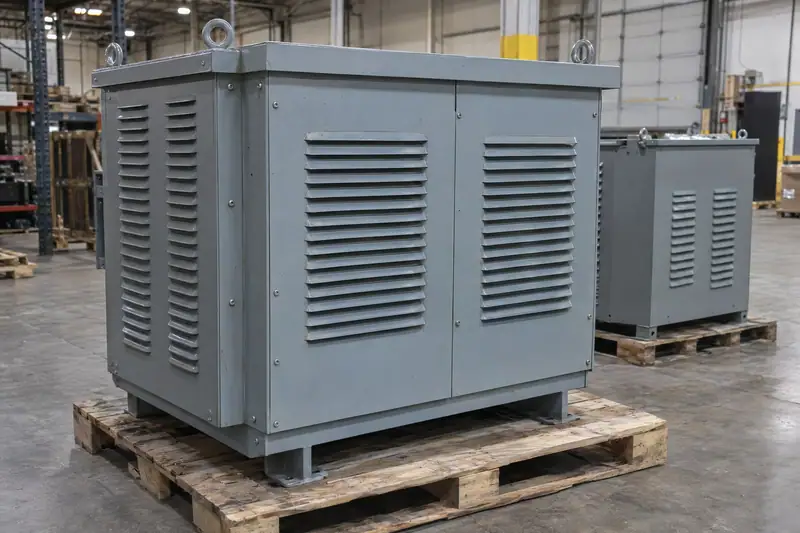
A 225 kVA transformer often serves a mid-size commercial building, school or process line. At this rating, we commonly see indoor dry-type units supplying building loads and outdoor three-phase pad-mount units stepping distribution voltage down to a usable service voltage. Those two forms share a capacity rating but have very different installation and handling requirements.
We buy all brands of 225 kVA three-phase transformers across Virginia. If you want to sell 225 kVA transformer equipment after a renovation, service change or plant shutdown, identify the actual unit rather than relying on a panel label or an old equipment schedule. Our transformer size guide helps distinguish the nameplate rating from the connected load.
01What a 225 kVA Three-Phase Rating Means
The 225 kVA rating describes the transformer's apparent-power capacity under its stated operating conditions. On a three-phase transformer, it is the total rating across all three phases, not 225 kVA per phase. It also is not automatically 225 kW: real power depends on the load's power factor.
Full-load current depends on voltage. For a three-phase secondary, the formula is amps = kVA × 1,000 ÷ (√3 × line-to-line volts). A worked example at 480 volts is 225 × 1,000 ÷ (√3 × 480), or approximately 270.6 amps. Use the amp table on this page to compare other voltages.
That calculation describes rated current, not a recommendation for breaker size, conductor size or installation design. Those decisions belong with your qualified electrical professionals. For more background on rating conversions, see the kVA and full-load amps guide.
02Common Voltage Combinations at 225 kVA
A familiar dry-type configuration is a 480-volt primary with a 208Y/120-volt secondary. It can supply receptacles, lighting and other lower-voltage loads within a building. Other 225 kVA dry-type units have different primary or secondary voltages, so the enclosure's appearance does not establish the electrical configuration.
A three-phase pad-mount unit may have a medium-voltage primary such as 12470GrdY/7200 and a secondary such as 480Y/277 or 208Y/120. The primary notation identifies a grounded-wye system voltage and its phase-to-neutral voltage. The secondary notation identifies line-to-line and line-to-neutral voltages.
We pay attention to the complete voltage designation, winding connection and tap information. A 225 kVA unit supplying 480Y/277 is not interchangeable with one supplying 208Y/120 simply because both have the same kVA rating. Include a readable connection diagram when one is available.
Full-load amps for a 225 kVA three-phase transformer
The amp table on this page uses the standard formula Amps = kVA × 1,000 ÷ (1.732 × line-to-line volts). Match the voltage on your nameplate to read the rated full-load current of each winding.
| Winding voltage | Full-load amps |
|---|---|
| 208 V | 625 |
| 240 V | 541 |
| 480 V | 271 |
| 600 V | 217 |
| 2,400 V | 54.1 |
| 4,160 V | 31.2 |
| 12,470 V | 10.4 |
| 13,200 V | 9.8 |
| 13,800 V | 9.4 |
| 23,000 V | 5.6 |
| 34,500 V | 3.8 |
03Confirm 225 kVA on the Nameplate
Look for the field marked kVA and confirm that the phase field says three-phase or 3 PH. Photograph the entire plate straight on, then take a closer image if small print is difficult to read. A cabinet stencil, shipping label or handwritten inventory entry is less useful than the manufacturer's plate.
Send the manufacturer, model or catalog number, serial number, frequency, primary and secondary voltages, and any listed impedance. On a dry-type unit, temperature rise and insulation information help identify the construction. On a liquid-filled unit, include the cooling designation, fluid identification and listed fluid quantity.
If the plate shows more than one capacity tied to cooling conditions, photograph every rating. ONAN and ONAF identify different liquid-filled cooling arrangements; do not assume the largest number applies without the associated equipment. A clear plate also helps resolve inventory confusion with a 150 kVA transformer or a 300 kVA unit.
04Dry-Type and Pad-Mount Units Need Different Photos
For 225 kVA dry-type equipment, show the enclosure, ventilation openings, mounting base and any visible damage. Note whether it operated indoors, was stored outside or came from a dusty or damp environment. Water exposure, damaged terminals and missing panels are important condition details. Our dry-type transformer page covers that equipment category.
For a 225 kVA pad-mount transformer, show the tank, cabinet doors, hinges, base and visible signs of leakage or corrosion. Tell us whether it is still on its pad or has already been removed. Identify dead-front or live-front construction from existing records or safely available photos; do not open energized compartments for pictures.
Fluid type and PCB status are separate questions. If records identify mineral oil or FR3 natural ester, include them, but do not infer PCB status from appearance or fluid branding. PCB status must be disclosed and documented. See our pad-mount equipment information for more on this construction.
05Physical Size, Weight and Reuse Fit
There is no single footprint or shipping weight for a 225 kVA transformer. Dry-type enclosure design, winding construction, temperature rise and accessories affect dimensions. A liquid-filled pad-mount unit also includes a tank, insulating fluid and cable compartments. Use the listed weight or manufacturer documentation rather than estimating from kVA.
For an indoor unit, doorway clearance, hallway turns and its position on a mezzanine or equipment-room floor can matter as much as its dimensions. For a pad-mount unit, describe vehicle access, surrounding obstacles and whether lifting points are visible. Photos of the route out help explain handling constraints without guessing.
The size has practical applications in commercial buildings, schools and dedicated process loads, but demand is configuration-specific. Voltage, condition, enclosure style and documentation determine how well a unit fits another application. A standard building-service configuration and a specialized process transformer should not be treated as equivalent inventory.
06What We Need to Make an Offer
Send a clear nameplate photo, overall photos, location, quantity and condition notes. For a 225 kVA unit, specify whether it is dry-type or liquid-filled, its voltage combination, and whether it remains connected. Include available test reports, fluid records, known faults, missing parts and storage history.
We review the information and may ask about PCB documentation, test data or site access. If the equipment fits, we send a written offer spelling out price, freight, loading and payment terms; pickup is scheduled with you, and payment follows those terms. See how the buying process works for details.
Ready to sell 225 kVA transformer equipment? Send the details through our offer request form. We do not perform electrical disconnect work or ask sellers to drain fluid; use your own qualified electricians to de-energize and disconnect the equipment.
Frequently asked questions
Can I sell a 225 kVA transformer removed during a school renovation?
Yes, Virginia Transformer Buyers buys used 225 kVA transformers removed during school renovations. Send the nameplate and condition photos, and note whether removal followed a service upgrade or an equipment fault. Include the voltage configuration and any available maintenance or test records. If it remains installed, have your own qualified electricians handle de-energizing and disconnecting.
Do you buy 225 kVA transformers with a 208Y/120 secondary?
Yes, we buy 225 kVA three-phase transformers with a 208Y/120 secondary. We also need the primary voltage, winding connection, equipment type and condition to identify the complete unit. The secondary voltage alone does not establish suitability for another installation. Photograph the nameplate and connection diagram rather than describing it only as a 208-volt transformer.
Can I sell a 225 kVA dry-type transformer with no enclosure?
Send photos and explain whether the 225 kVA dry-type transformer was built as an open unit or is missing its original enclosure. That distinction matters because original construction and missing components are different conditions. Include the nameplate, mounting arrangement and known damage. Failed or damaged units are reviewed case by case.
Is a 225 kVA pad-mount transformer worth offering if it leaks?
You can submit a leaking 225 kVA pad-mount transformer for case-by-case review, but disclose the leak and any known failure. Send safely taken exterior photos, the nameplate and available fluid records. PCB status must be disclosed and documented. We do not ask you to drain fluid or provide environmental advice.
What if my 225 kVA transformer's nameplate is unreadable?
Send the clearest photos available along with manufacturer drawings, purchase records or equipment schedules that may identify the 225 kVA transformer. Explain which details are confirmed and which are uncertain. We may need additional information before making an offer. Do not assume the rating from a nearby panel or from the size of the enclosure.