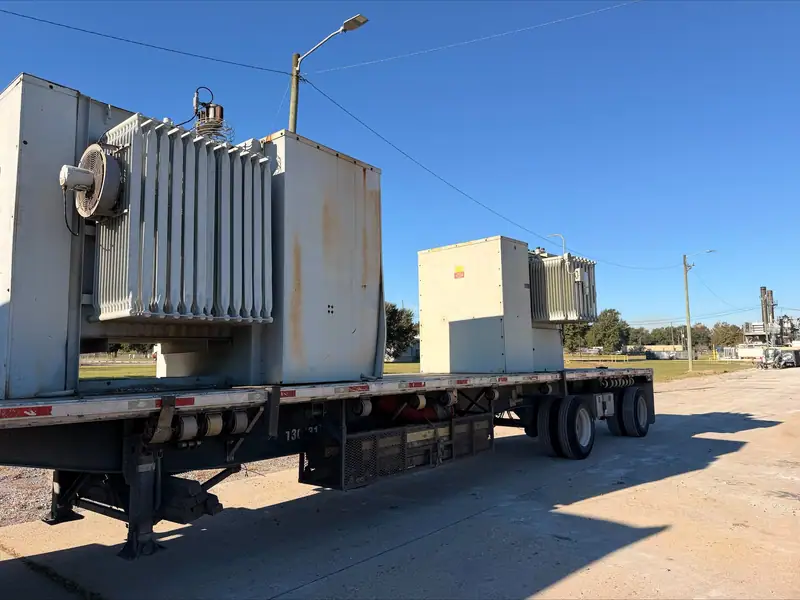
A 7.5 MVA transformer can be a substantial asset in an industrial substation, municipal distribution system or generation site. We buy new-surplus, used and decommissioned equipment at this size across all brands. The useful starting point is the actual nameplate, not just an equipment schedule that calls the unit a “7.5 MVA transformer.”
At this rating, winding configuration, cooling stages and transport dimensions can distinguish two otherwise similar units. If you plan to sell 7.5 MVA transformer equipment, this page explains the details we need and why they matter. Our transformer size guide covers other ratings when your inventory includes more than one capacity.
01What the 7.5 MVA rating actually means
A 7.5 MVA rating represents 7,500 kVA of apparent power. It is not automatically 7.5 MW of usable real power: real power depends on power factor, and the permissible loading also depends on the transformer’s stated operating conditions. For a three-phase unit, the nameplate rating applies to the complete transformer, not to each phase separately.
Pay particular attention to multiple cooling ratings. A plate might list 5/6.25/7.5 MVA, with the highest capacity dependent on forced-air cooling. That is different from a transformer rated 7.5 MVA at its base cooling stage. ONAN identifies natural oil and natural air cooling; ONAF adds forced-air cooling.
We need every listed capacity and its corresponding cooling designation. Include ambient or temperature-rise information shown on the plate, along with photos of fans and their controls. If 7.5 MVA appears only as the upper cooling rating, do not describe the equipment as a base-rated 7.5 MVA unit.
02Voltage combinations and current at this size
Voltage combinations you may encounter include 34.5 kV to 13.8 kV, 69 kV to 13.8 kV, and 13.8 kV to 4.16 kV. These are examples, not requirements for an offer. Industrial distribution, municipal systems and generation connections use different arrangements, and a generation step-up application may use a different low-voltage winding.
Copy the winding ratings exactly. A grounded-wye designation, such as 12470GrdY/7200, conveys information that “12 kV” leaves out. Delta or wye connections, available neutrals, tap range and basic impulse insulation level also matter. We pay attention to those details because matching capacity alone does not establish electrical compatibility.
For three-phase equipment, full-load current is I = VA ÷ (√3 × line-to-line volts). One example is 7,500,000 ÷ (√3 × 13,800), which gives approximately 314 amps at 13.8 kV. Use the amp table on this page for other listed voltages, or consult the transformer kVA and full-load amps guide. These calculations do not replace an installation design.
Full-load amps for a 7.5 MVA three-phase transformer
The amp table on this page uses the standard formula Amps = kVA × 1,000 ÷ (1.732 × line-to-line volts). Match the voltage on your nameplate to read the rated full-load current of each winding.
| Winding voltage | Full-load amps |
|---|---|
| 208 V | 20,818 |
| 240 V | 18,042 |
| 480 V | 9,021 |
| 600 V | 7,217 |
| 2,400 V | 1,804 |
| 4,160 V | 1,041 |
| 12,470 V | 347 |
| 13,200 V | 328 |
| 13,800 V | 314 |
| 23,000 V | 188 |
| 34,500 V | 126 |
03Substation and power transformer configurations
We buy 7.5 MVA substation transformers and power transformers. At this capacity, equipment may have exposed bushings, enclosed termination chambers or connections arranged for adjoining switchgear. Photograph each connection side so we can see the configuration rather than infer it from the rating.
Industrial units may serve plant distribution buses, while municipal units may connect higher-voltage supply to local distribution. At generation sites, winding voltages and connections reflect the generator or collection system and the grid connection. Tell us the unit’s previous application, but use the nameplate to establish its actual electrical ratings.
Accessories can materially change what is included in a sale. Identify radiators, conservators, fans, gauges, tap-changing equipment, neutral bushings and control cabinets. If adjoining switchgear or a separate control enclosure is not included, say so. A complete inventory helps distinguish the transformer itself from the surrounding substation equipment.
04How to confirm a 7,500 kVA unit on the nameplate
Look for a three-phase rating marked 7,500 kVA, 7500 kVA or 7.5 MVA. Then check whether that number is one of several cooling-stage ratings. Send a straight-on photo sharp enough to read the smaller fields, plus separate close-ups if glare or weathering obscures the plate.
The most useful fields are manufacturer, serial number, year, frequency, winding voltages, rated kVA, impedance, cooling class and winding connections. Include tap positions and any separate tap-changer plate. Impedance is especially relevant when equipment is intended to operate in parallel, although compatibility must be determined by the seller’s or end user’s qualified professionals.
Fluid and weight information may appear on the main plate or separate labels. Photograph those too, including labels identifying mineral oil or FR3 natural ester. PCB status must be disclosed and documented; a fluid label alone is not a substitute for PCB documentation. Do not drain fluid to prepare the transformer for sale.
05Physical size, weight and pickup access
There is no single transport weight or footprint for a 7.5 MVA transformer. Voltage class, tank construction, cooling arrangement, fluid volume and accessories all affect the dimensions. A higher-voltage unit can have very different bushing clearances and shipping requirements from an industrial unit with the same MVA rating.
Send the nameplate weight and measured overall dimensions when available. Distinguish total operating weight from shipping weight, and identify whether the listed dimensions include radiators, bushings or a conservator. If accessories have already been removed, photograph them separately and explain where they are stored.
Site photos should show the route from the transformer to the loading area, overhead obstructions, gates and nearby structures. Tell us whether the unit is on a foundation, indoors or already staged for transport. We do not perform electrical disconnect work; sellers use their own qualified electricians to de-energize and disconnect equipment.
06What drives interest and what we need for an offer
Interest in a 7.5 MVA transformer depends on its fit for a specific electrical application, not just its capacity. Voltage ratio, impedance, cooling capability, condition and completeness are important. A documented unit with intact accessories gives us more useful information than an unidentified transformer described only by its approximate size.
A 5,000 kVA transformer or a 10 MVA transformer is not automatically interchangeable with a 7.5 MVA unit. Available capacity is only one factor; protection, connections, physical space and system requirements also matter. We buy all these sizes, but each unit needs its own equipment description.
Send clear nameplate and overall photos, location, quantity and condition notes through the offer form. We review the equipment and may ask about PCB documentation, test data or access. If it fits, our written offer states price, freight, loading and payment terms; pickup is scheduled with you and payment follows those terms. See how the sale works for details.
Frequently asked questions
Can I sell a transformer marked 5/6.25/7.5 MVA?
Yes, we buy transformers with multiple ratings that include 7.5 MVA. Send the complete rating plate so we can identify the capacity at each cooling stage. Include photos and condition notes for the fans, radiators and controls, since the highest rating may depend on forced-air cooling rather than natural cooling alone.
Is 7,500 kVA the same size as 7.5 MVA?
Yes, 7,500 kVA equals 7.5 MVA. On a three-phase transformer nameplate, that rating describes the complete unit’s apparent-power capacity under its stated conditions. Check the cooling designations before assigning the size, because a plate can list several capacities and identify 7,500 kVA only as the highest fan-cooled rating.
Will you buy a 7.5 MVA generation step-up transformer?
Yes, we buy 7.5 MVA generation-site transformers, including solar and wind units. Send both winding voltages, connections, cooling ratings and the complete nameplate. Note whether bushings, radiators, controls and other accessories are included, and describe any known faults. Failed or damaged units are reviewed case by case.
Can I sell a 7.5 MVA transformer with missing radiators?
A 7.5 MVA transformer with missing radiators is reviewed case by case as incomplete or damaged equipment. Identify exactly what is missing and whether the original radiators are stored elsewhere. Send photos of the tank connections and remaining accessories, and disclose any leaks or exposure. Do not drain fluid for the sale.
Do I need recent test results to sell my 7.5 MVA transformer?
Send any available test results, but start with the nameplate, photos and an accurate condition history if you do not have them. We may ask for additional information during review. Useful records can include transformer electrical tests and fluid-analysis reports; identify their dates and any faults or repairs that occurred afterward.