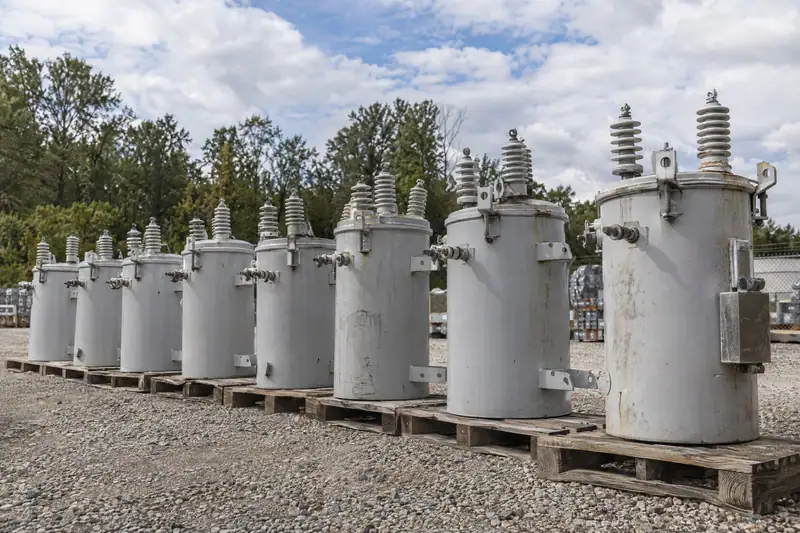
We buy surplus and used Central Moloney distribution transformers from sellers throughout Virginia. Central Moloney builds distribution transformers in Pine Bluff, Arkansas, and its units are common on utility and cooperative systems across the Southeast and Mid-Atlantic. For a seller, the important distinction is the actual equipment configuration: an overhead single-phase unit, a single-phase pad-mount or a three-phase pad-mount.
A manufacturer's name identifies the equipment, but it does not establish its rating, condition or suitability for another installation. We pay attention to the nameplate and the complete assembly rather than treating every Central Moloney unit alike. Our transformer brands page covers other equipment we buy; brand names describe equipment only and do not imply a manufacturer affiliation.
01Central Moloney configurations we buy
We buy Central Moloney single-phase distribution transformers from 10 kVA and three-phase units from 15 kVA. Used equipment and new surplus are both welcome. Keep the mounting configuration clear when describing a unit: a pole-mount transformer and a pad-mount transformer with the same kVA rating are not interchangeable assemblies.
For single-phase pole-mount transformers, show the tank, mounting brackets, high-voltage bushings and secondary terminals. For single-phase pad-mount equipment, photograph the cabinet exterior and any safely accessible existing images of the connection compartment. Three-phase pad-mounts need enough detail to identify the voltage arrangement, terminal configuration and cabinet condition.
- Single-phase pole-mount: identify the individual unit rating and whether it belongs to a bank.
- Single-phase pad-mount: identify primary voltage, secondary voltage and connection arrangement.
- Three-phase pad-mount: identify three-phase kVA, primary and secondary connections, and any listed switching or fusing.
02Read the nameplate before describing the unit
Start with one sharp photograph of the entire nameplate, then add close-ups if the stamped fields are faint. We need the manufacturer, serial number, kVA, phase, frequency, primary voltage, secondary voltage and connection diagram. Include the manufacturing year or date if shown, plus impedance, tap information and listed fluid type. Our transformer nameplate guide explains how these fields work together.
Copy voltage markings exactly. A primary marking such as 12470GrdY/7200 carries connection information that is lost if it is shortened to '12 kV.' Likewise, distinguish a 120/240 V single-phase secondary from a 480Y/277 V three-phase secondary. If the plate is missing or unreadable, say so; a serial number or painted asset number alone does not establish the electrical ratings.
03What matters beyond kVA on Central Moloney units
Matching kVA ratings do not make two distribution transformers equivalent. We pay attention to primary and secondary voltages, phase, taps, impedance and terminal arrangement. On three-phase pad-mount transformers, identify whether the primary compartment is dead-front or live-front and whether the configuration is radial-feed or loop-feed. Use the nameplate, drawings and existing records rather than guessing from the outside of a closed cabinet.
Completeness also matters. Tell us about missing bushings, damaged terminals, removed fuses, altered switching components or cabinet parts that are no longer with the unit. On pole-mount equipment, note damaged mounting brackets and whether protective components are present. If several units formed a three-phase bank, list each transformer's rating and serial number separately; do not substitute the bank total for each unit's nameplate kVA.
04Condition, fluid records and failed equipment
Describe the equipment's actual history: unused surplus, removed from service while operating, long-term stored, or failed. Include visible leaks, tank corrosion, damaged bushings and cabinet deterioration. A unit removed during a system upgrade presents a different condition picture from one removed after a fault. Existing test reports are useful when available, but do not call an untested transformer 'tested good.'
PCB status must be disclosed and documented. Provide available fluid labels, analytical records or other relevant documentation, and disclose uncertainty rather than inferring status from age alone. If records identify mineral oil or FR3 natural ester, include them. We do not ask sellers to drain fluid. Failed or damaged Central Moloney units are reviewed case by case; describe the failure, any fluid loss and any parts removed afterward.
05Virginia sources and mixed distribution inventories
Central Moloney equipment can become surplus through utility and cooperative inventory changes, feeder upgrades, contractor project changes and replacement of privately owned distribution equipment. In Virginia, a seller may have a single spare pole-mount, several unused residential pad-mounts or a three-phase unit removed from a commercial site. We serve sellers in every region of the state, including coastal, Piedmont, Valley and Southwest locations.
For mixed inventories, separate the list by manufacturer, configuration and rating. A row for each serial number helps distinguish similar-looking units with different voltages or service histories. State who owns the equipment and whether it remains installed, sits in storage or is staged for loading. Equipment on a property is not necessarily owned by the property owner, particularly where a utility supplies the transformer.
06Prepare a useful Central Moloney offer request
If you want to sell Central Moloney transformer equipment, send clear nameplate and overall photos, location, quantity and condition notes through our offer request form. We review the information and may ask about PCB documentation, test data or access. If the equipment fits, our written offer states price, freight, loading and payment terms; pickup is scheduled with you, and payment follows those terms. See how the buying process works for details.
Identify access restrictions before scheduling: locked utility yards, narrow gates, soft ground or equipment still attached to a pole or foundation. We do not perform electrical disconnect work. Sellers use their own qualified electricians to de-energize and disconnect equipment. Do not open energized compartments or move a transformer just to obtain a better photograph.
Frequently asked questions
Do you buy a single Central Moloney pole-mount transformer?
Yes, we buy individual Central Moloney single-phase pole-mount transformers from 10 kVA, as well as groups of units. Identify the individual nameplate rating, primary and secondary voltages, and whether it was part of a bank. Include photos of the tank, bushings and mounting brackets, plus condition notes and documented PCB status.
Can I sell unused Central Moloney pad-mounts left over from a project?
Yes, we buy new-surplus Central Moloney single-phase and three-phase pad-mount transformers. Unused does not necessarily mean complete or undamaged, so disclose storage conditions, missing components and any handling damage. Nameplate photos should show each unit's ratings, and overall photos should show cabinet and tank condition. Identify differing voltage configurations separately.
Does the year on a Central Moloney nameplate determine its value?
No, the manufacturing year alone does not determine an offer for a Central Moloney transformer. We review the rating, voltage connections, configuration, completeness, condition and relevant records together. Include the year when shown, but do not use it as a substitute for operating history or documented PCB status.
Can you review a Central Moloney unit with a missing nameplate?
Yes, we can review the available information, but a missing nameplate makes identification harder. Send overall photos, any remaining serial markings and records clearly tied to that specific unit. Original drawings or inventory records may help establish ratings. Do not infer voltage or kVA solely from tank dimensions or another transformer beside it.
Do you buy failed Central Moloney distribution transformers?
Failed Central Moloney transformers are reviewed case by case. Explain whether the reported problem involved a winding fault, leaking tank, damaged bushing or another issue, and include existing reports if available. Disclose fluid loss, removed components and documented PCB status. Whether we make an offer depends on the specific equipment and its condition.
Are you Central Moloney or an authorized manufacturer representative?
No, Virginia Transformer Buyers is an independent equipment buyer and is not affiliated with Central Moloney or any other manufacturer. We use the Central Moloney name only to identify transformers offered by sellers. This page concerns buying surplus and used equipment, not manufacturer warranty service, factory support or replacement-parts representation.