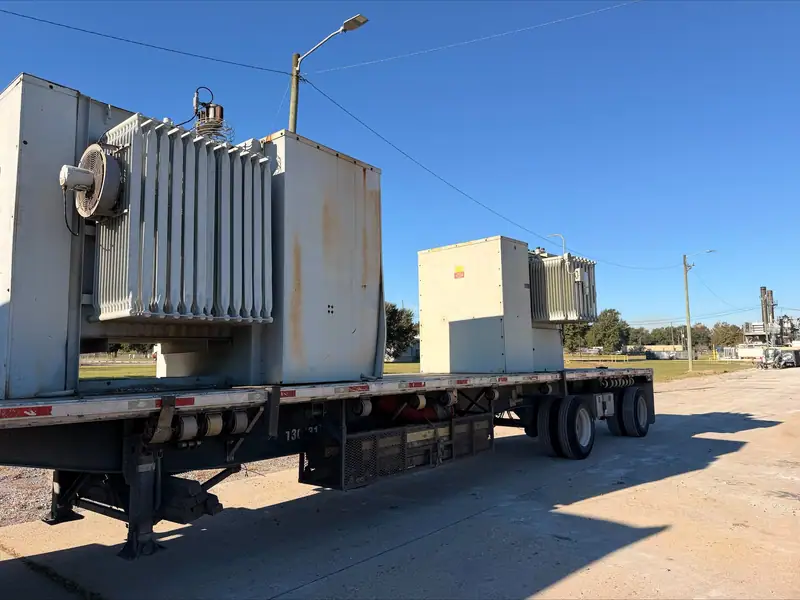
A transformer sitting on a concrete pad is not automatically a pad-mount transformer. Substation transformers also sit on foundations, and some have enclosed terminal compartments. The useful distinction is how the transformer protects its energized connections, connects to other equipment and fits into the installation.
For sellers comparing pad-mount vs substation transformers, the cabinet and bushings usually tell more than paint color or physical footprint. We buy both categories across Virginia, including new-surplus, used and decommissioned equipment. This guide explains the features we look for in photos and nameplates; our other transformer seller guides cover related preparation and selling questions.
011. Construction: a secured cabinet versus a substation arrangement
A typical liquid-filled pad-mount transformer combines the tank with a secured cable compartment. High-voltage and low-voltage connections are generally behind cabinet doors, often in separate sections. This arrangement supports ground-level installation where access to energized parts must be restricted. Pad-mounted equipment can be single-phase or three-phase, with cabinet shapes that vary considerably.
A substation transformer is built for an installation with controlled access or integration into an electrical lineup. It may have exposed bushings on the tank, enclosed terminal chambers, bus connections or close-coupled connections to switchgear. A unit substation commonly combines primary equipment, a transformer and secondary distribution equipment. The transformer itself may be liquid-filled or dry-type equipment, so a tank is not a universal identifying feature.
| Feature | Pad-mount transformer | Substation transformer |
|---|---|---|
| Connection protection | Integral secured cable cabinet | Exposed bushings, terminal chambers or switchgear connections |
| Common cable arrangement | Underground cables entering beneath the cabinet | Cable, overhead conductor or bus connections |
| Typical installation | Ground-level distribution near the load | Controlled-access substation or integrated equipment lineup |
| Useful identification photos | Complete cabinet, doors and exterior labels | Tank or enclosure, bushings and equipment interfaces |
022. Bushings and cable connections are strong identification clues
On a dead-front pad-mount transformer, high-voltage cables typically connect through insulated separable connectors, commonly called elbows. Photos or drawings may show bushing wells, inserts, parking stands and loadbreak or deadbreak interfaces. A live-front pad-mount design instead has connections to exposed terminals inside the secured compartment. Do not assume every pad-mount uses elbows or that every elbow has the same current rating.
Substation units often have porcelain or polymer bushings extending from the tank or terminal chambers. Low-voltage connections may be bushings, spade terminals, bus duct or an interface to adjacent gear. We pay attention to bushing condition, terminal configuration and missing connection hardware because replacements must suit the equipment. Photograph visible components from a safe position; do not open an energized compartment or remove protective covers to identify the transformer.
- Record whether primary connections are dead-front, live-front, exposed bushings or enclosed terminals.
- Note radial-feed or loop-feed arrangements when shown on the nameplate or connection diagram.
- Include photos of damaged bushings, missing elbows or incomplete terminal hardware when safely accessible.
033. Cooling and insulating medium do not define the category
Both pad-mount and substation transformers can be liquid-filled. Mineral oil and natural ester fluids, including FR3, appear in these applications. Cooling fins or radiator panels are another clue to construction, but they do not independently establish the transformer category. The nameplate or fluid label is the right source for identifying the specified insulating liquid; appearance alone is not reliable.
ONAN means oil natural, air natural cooling. ONAF adds forced-air cooling, typically using fans, and the nameplate may list separate ratings for different cooling stages. Record every listed rating rather than advertising only the largest number. For older liquid-filled units, PCB status must be disclosed and documented; fluid brand or age alone does not establish PCB status. We do not ask sellers to drain fluid.
044. Capacity, voltage and application: where the categories overlap
There is no single kVA dividing line between these types. Pad-mount equipment spans small single-phase distribution units through larger three-phase designs. Substation equipment also covers a broad range, including MVA-class power transformers. We buy single-phase transformers from 10 kVA and three-phase transformers from 15 kVA through MVA-class equipment. A 225 kVA transformer, for example, cannot be classified by capacity alone.
Pad-mount units commonly supply buildings, campuses and other loads through underground distribution; solar and wind installations also use pad-mounted equipment. Substation transformers serve utility and industrial distribution, large facilities and generating installations. Record the complete voltage designation, such as 12470GrdY/7200 and 480Y/277, along with phase and frequency. Our kVA and full-load amps guide explains capacity-related current calculations, but voltage and connections still matter when matching equipment.
055. Accessories and completeness affect buyer evaluation
For pad-mount equipment, we look at the condition of the cabinet, door hardware, barriers and cable-entry area, as well as the tank. Depending on the design, internal equipment may include fuses, switching devices and surge arresters. Identify those features from labels, drawings or safely available photos rather than assuming they are present. Corrosion near the cabinet base and damaged doors deserve clear close-ups.
For substation equipment, we pay attention to radiator assemblies, fans, terminal chambers, gauges and any separately stored components. Larger units may have conservators, pressure-relief devices or protective accessories, but not every design includes them. Tell us whether radiators, bushings, fans and connecting sections remain with the transformer. A missing accessory is different from an electrical failure; explain any known fault so failed or damaged equipment can be reviewed case by case.
- Photograph fluid-level and temperature indicators where fitted.
- List detached parts and identify which transformer they belong to.
- Disclose leaks, damaged terminals, cabinet corrosion and known electrical faults.
066. How to tell which transformer you have from photos
Start with an overall photograph showing the full transformer and its surroundings. An integral locked cabinet with underground cable entry points strongly suggests a pad-mount arrangement. Prominent tank-mounted bushings, terminal chambers or connections to an adjacent switchgear lineup suggest a substation arrangement. Include the opposite side too: a front view can hide radiators, terminal interfaces and other identifying features.
Next, photograph the complete nameplate straight on so the ratings and connection diagram are readable. We need more than a cropped kVA number. Capture manufacturer, serial number, phase, frequency, primary and secondary voltages, taps, impedance, cooling ratings and weight when listed. If the nameplate references an IEEE C57 standard, leave that information visible. Labels and drawings help resolve ambiguous enclosures without requiring unsafe access.
- One wide view showing the cabinet or tank and nearby equipment.
- Front, rear and side views showing doors, radiators and connection locations.
- A readable nameplate and any separate fluid or PCB documentation.
- Close-ups of visible damage and loose accessories.
077. What we evaluate before making an offer
When reviewing pad-mount vs substation transformers, we match the electrical ratings with the physical configuration and condition. We pay attention to voltage compatibility, connection arrangement, cooling stages, completeness and available test records. Size alone does not tell us whether a transformer fits. Installed units also require clear information about access, approximate weight and whether the equipment has been disconnected by the seller's qualified electrician.
Send nameplate and overall photos, location, quantity and condition notes through the offer form. We review the information and may ask about PCB documentation, test data or site access; if the equipment fits, our written offer specifies price, freight, loading and payment terms, with pickup scheduled with you and payment following those terms. See how the buying process works for details.
Frequently asked questions
Is every transformer on a concrete pad a pad-mount transformer?
No, a concrete foundation does not make a transformer a pad-mount unit. Substation transformers also stand on pads or foundations. Look for an integral secured cable cabinet and the connection arrangement, then confirm with the nameplate or drawings. A transformer with exposed tank-mounted bushings may be substation equipment even though it sits at ground level.
Can a pad-mount transformer have live-front connections?
Yes, pad-mount transformers can have live-front or dead-front primary connections. Dead-front designs generally use insulated separable cable connectors; live-front designs have exposed connection points inside the secured compartment. The distinction matters when identifying replacement applications and included hardware. Do not open energized doors to check; use existing documentation or photos taken under safe, qualified access.
Is a unit substation the same thing as its transformer?
No, a unit substation generally includes more than the transformer alone. It commonly combines primary switching or protective equipment, the transformer and secondary distribution equipment in an integrated arrangement. When offering equipment, identify which sections are included and photograph their interfaces. The transformer rating does not describe every attached switchgear section or its electrical ratings.
Does an ONAF rating mean my transformer is a substation type?
No, ONAF describes a cooling arrangement, not the enclosure category. It indicates oil circulation by natural convection with forced-air cooling. Identification still depends on the cabinet, bushings and equipment connections. Include all nameplate capacity ratings and show whether the fans and controls associated with the forced-air rating are present.
Can I sell a pad-mount transformer with the elbows missing?
Yes, we buy pad-mount transformers with missing connection hardware when the equipment fits, but you should disclose what is absent. Missing elbows do not by themselves establish an internal transformer failure. Photograph the safely accessible interfaces and identify any remaining hardware. If there is known electrical damage, describe it separately for case-by-case review.
Should I disconnect a substation transformer before sending photos?
No, you do not need to disconnect a substation transformer just to send safely obtainable exterior and nameplate photos. Tell us whether it remains installed or energized, and avoid entering restricted areas or opening covers. We do not perform disconnect work; sellers use their own qualified electricians. Our decommissioning checklist outlines information to gather before equipment moves.