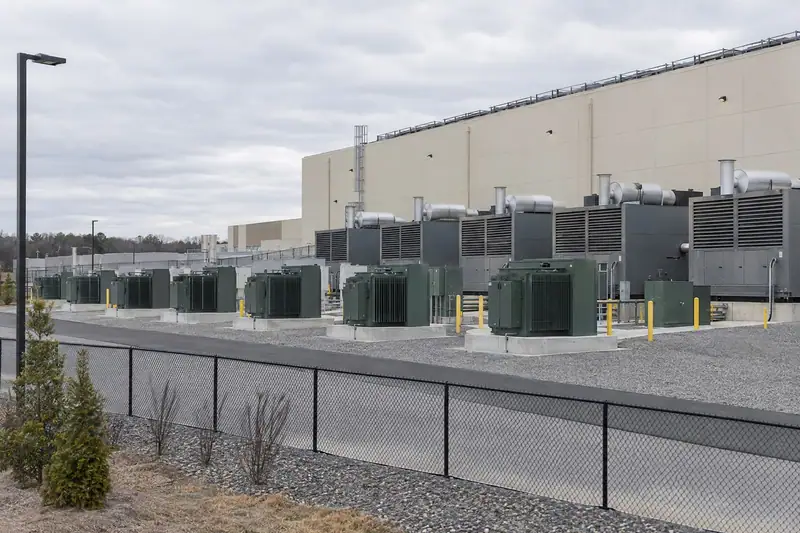
Since roughly 2021–2022, transformer shortages and extended delivery schedules have been widely reported across the electrical industry. Distribution equipment has been affected, and large power transformers can be especially difficult to source on a project's preferred schedule. The pressure comes from several markets expanding or replacing equipment at the same time.
For Virginia sellers, this explains why surplus transformers are in demand, but it does not mean every stored transformer is interchangeable with a newly ordered unit. A spare with the right voltage, capacity and configuration may be useful; another may have limited applications. Our seller guides help owners separate useful equipment details from broad market headlines.
01Several Sources of Demand Are Competing for Capacity
Data centers need substantial electrical infrastructure to distribute power to computing equipment, cooling systems and supporting loads. Their construction can create demand across multiple transformer classes, not just one large unit at a utility connection. In Virginia, data center development makes this pressure particularly relevant to sellers of commercial and industrial equipment.
Electrification adds other loads, including vehicle charging, electric heating and industrial equipment. Solar and wind projects also need transformers to connect generation at appropriate voltages. These projects do not all use the same designs, but they draw on overlapping manufacturing resources, materials and component supply chains.
Utilities must also replace aging equipment, maintain spares and restore service after failures or storm damage. That work continues even when new construction slows. Understanding why surplus transformers are in demand starts with this overlap: replacement needs and new load growth can compete for available production slots.
02Why New Transformer Delivery Can Take So Long
A transformer is not simply an enclosure assembled around readily interchangeable parts. Production depends on electrical steel, winding conductors, insulation systems, bushings and other components. Material constraints, component availability and factory capacity can all affect schedules. Published lead-time reports describe market conditions, not a delivery promise for a specific order.
Distribution transformers often involve repeatable designs, but large order volumes can still create backlogs. Large power transformers are frequently project-specific, with detailed voltage, impedance, cooling, accessory and transport requirements. Engineering, fabrication and testing add steps that cannot always be compressed just because a buyer needs equipment sooner.
Lead times vary by manufacturer, design and order date. Sellers should be cautious about quoting a headline delay as though it applies to every transformer. A surplus dry-type unit for an indoor facility and a high-voltage substation transformer serve different needs; our dry-type versus oil-filled guide explains important construction differences.
03Where Surplus and Spare Units Can Be Useful
Surplus equipment can provide an alternative sourcing route when a suitable unit already exists. Examples include an unused transformer left after a canceled project, a spare no longer needed at a facility, or serviceable equipment removed during an upgrade. Existing availability can matter when a project cannot align its schedule with a new factory order.
The key word is suitable. A surplus transformer may support a permanent installation or a replacement need, but the intended user must determine whether it meets the application. Availability alone does not establish suitability, and a buyer should not treat a similar kVA rating as proof that two units can substitute for each other.
We buy new-surplus, used and decommissioned transformers across Virginia, including pad-mount, dry-type, oil-filled and substation transformers. A spare held indoors with intact accessories presents a different equipment story from a unit removed after a fault. Failed units are reviewed case by case rather than treated as ready-to-use replacements.
04Electrical Fit Matters More Than the Shortage Headline
We pay attention to the full nameplate, not just the largest number printed on it. Capacity, phase, frequency, primary and secondary voltage, winding connections and impedance help identify the unit's potential applications. A primary marked 12470GrdY/7200 and a secondary marked 480Y/277 communicate much more than a seller's description of a 'commercial transformer.'
Physical configuration matters too. Pad-mount compartments, dead-front or live-front connections, bushing arrangements and enclosure dimensions can affect installation compatibility. On larger units, cooling classes such as ONAN/ONAF identify different operating ratings. Tap ranges, accessories and liquid type, including mineral oil or FR3 natural ester, also belong in the equipment description.
This is why surplus transformers are in demand selectively, not uniformly. Even a common capacity such as 2,000 kVA can cover materially different configurations. We buy all brands and sizes, from single-phase units of 10 kVA and three-phase units of 15 kVA through MVA-class power transformers, but each unit's details still shape the buying decision.
- Photograph every nameplate when a unit has separate cooling or accessory ratings.
- Record primary and secondary voltages exactly, including connection markings.
- Identify missing bushings, cabinets, gauges or other visible components.
- Distinguish unused surplus from equipment that previously operated in service.
05Condition and Records Make Availability More Meaningful
A transformer sitting in storage is not automatically installation-ready. Storage conditions, moisture exposure, leaks, corrosion, damaged bushings and missing components can affect its usefulness. Sellers should describe what they know, including whether the unit was operating when removed and whether a fault, overheating event or other problem prompted removal.
Existing test reports and maintenance records can help explain condition. For liquid-filled units, oil test results may provide information about the fluid and internal condition, but one report does not establish every aspect of readiness. Our transformer oil testing guide explains what common tests address. PCB status must be disclosed and documented; unknown status should be stated plainly.
Keep removal history separate from guesses about performance. Sellers use their own qualified electricians to de-energize and disconnect equipment; we do not perform electrical disconnect work or ask sellers to drain fluid. The decommissioning checklist covers seller preparation without treating market demand as a reason to skip safe isolation or documentation.
06Strong Demand Does Not Guarantee a Particular Offer
A shortage can make usable surplus more relevant without making every unit equally valuable. Voltage configuration, condition, completeness, documentation and location all matter. A transformer with a narrow application or difficult loading requirements may draw a different offer from a broadly usable unit, even when both have the same kVA rating.
New-equipment replacement cost is not a reliable shortcut to a surplus sale price. A buyer must account for the equipment's actual configuration and the costs and uncertainties associated with moving it into another application. Sellers should be wary of claims that a shortage guarantees premium pricing, immediate resale or acceptance regardless of condition.
Send a clear nameplate photo, overall photos, location, quantity and condition notes through the offer form. We review the equipment and may ask about PCB status, test data or site access; if it fits, we send a written offer specifying price, freight, loading and payment terms, then schedule pickup with you. Payment follows those terms; see how the purchase works for details.
Frequently asked questions
Does the transformer shortage mean my used transformer is worth more?
The shortage does not automatically increase the value of every used transformer. Demand can improve interest in equipment with useful electrical specifications, but condition, documentation and logistics remain important. Virginia Transformer Buyers bases its written offer on the actual equipment, not on an assumed percentage of new replacement cost or a general shortage headline.
Are surplus distribution transformers and large power transformers in demand for the same reasons?
They share some demand drivers, but they serve different applications and face different sourcing constraints. Distribution equipment supports local voltage conversion, while large power transformers serve higher-capacity transmission, generation and substation needs. Factory capacity can affect both markets, but a surplus distribution unit cannot fill a large power transformer requirement simply because both are difficult to source.
Is an unused spare automatically more useful than a used transformer?
An unused spare is not automatically more useful than a used transformer. Its specifications still must fit an application, and storage history can affect condition. A documented, serviceable used unit may have a clearer equipment history than an unused unit stored poorly. Identify the spare as unused, but also disclose storage conditions, missing parts and any known damage.
Can a buyer use a surplus transformer with a different voltage?
A different voltage rating can prevent a surplus transformer from fitting the intended application. Tap settings provide only the adjustment range specified for that unit; they do not make arbitrary voltage substitutions possible. The intended user's qualified professionals must determine compatibility. Virginia Transformer Buyers does not provide engineering advice or promise that a unit can be adapted.
Should I wait for shortages to get worse before selling a spare?
Waiting for shortages to worsen does not guarantee a better offer. Demand, manufacturing availability and project requirements change, while stored equipment may deteriorate or become less relevant to available applications. First determine whether your site still needs the spare. If it is genuinely surplus, evaluate an actual written offer rather than trying to predict the market's peak.
Does strong demand make failed transformers easier to sell?
Strong demand does not make a failed transformer equivalent to serviceable surplus. Virginia Transformer Buyers reviews failed units case by case, using the specifications and available information about the failure. Describe fault events, leaks, visible damage and existing test results accurately. PCB status must also be disclosed and documented, regardless of current market demand.